
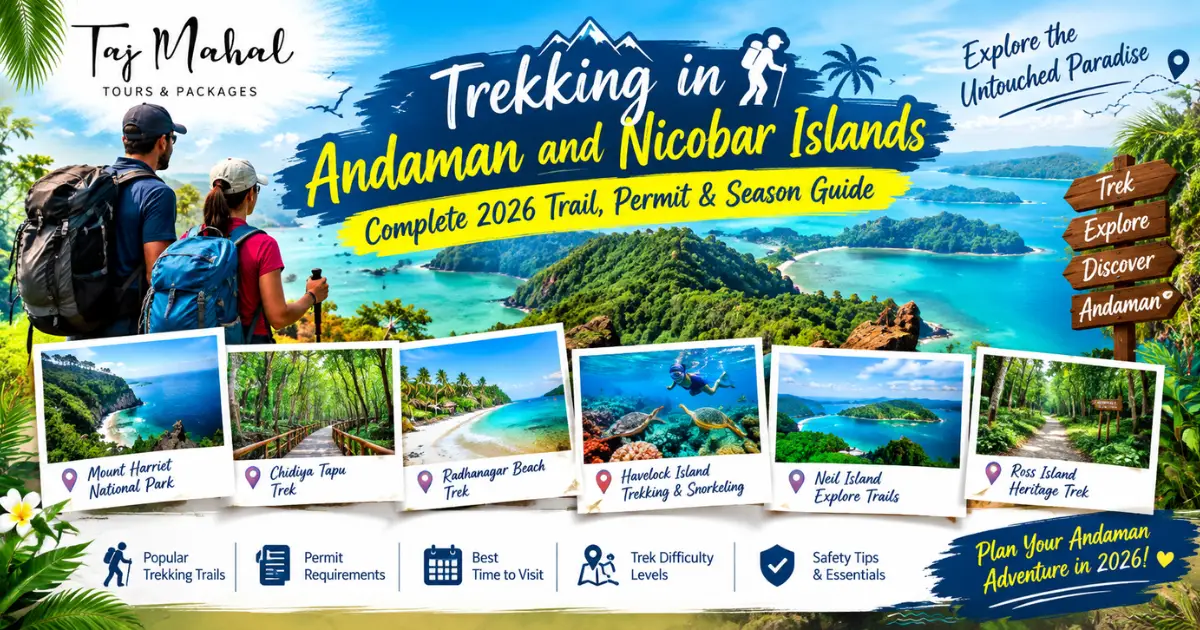
Trekking in Andaman and Nicobar Islands is not just about beaches — it is about rainforest trails, limestone caves, and the highest peak in the archipelago. If you are planning trekking in Andaman and Nicobar Islands, this guide covers the best trails, permits, the right season, packing checklist, and a comparison of trekking with other island adventures, so you can plan a safe and well-informed trip from start to finish.
Why Trek in Andaman and Nicobar Islands
Most visitors only see the Andaman coastline from a beach chair or a ferry deck. Trekking flips that view completely. The islands hide tropical evergreen forests, mangrove creeks, freshwater streams, and viewpoints that no boat trip can reach.
The Andaman & Nicobar Islands are officially recognised for their rich biodiversity, with protected zones such as Saddle Peak National Park and Mount Harriet National Park managed by the region's forest department for conservation and eco-tourism.
Here is a quick snapshot before you dive into the trails.
| Aspect | Details |
|---|---|
| Best islands for trekking | North Andaman (Diglipur), South Andaman (Port Blair), Havelock (Swaraj Dweep), Baratang, Long Island |
| Best season | November to April |
| Trail difficulty range | Easy (1–2 hrs) to Difficult (full day) |
| Highest trekking point | Saddle Peak, 732 m (North Andaman) |
| Permit needed | Yes, for national park and forest trails |
| Guide required | Recommended; mandatory on several trails |
| Ideal trip length for trekking + islands | 6–8 days |
Unlike mainland Himalayan treks, Andaman trails are short in distance but rich in variety — you can walk through rainforest, cross a mangrove creek, and step onto a white-sand beach all within the same route. This mix of terrain is exactly why trekking here appeals to both first-time hikers and experienced trekkers looking for something different.
How to Reach the Main Trekking Hubs
Andaman trekking is spread across a few key islands, and each one is reached differently from Port Blair, the main gateway.
| Trekking Hub | Trails Located Here | How to Reach from Port Blair |
|---|---|---|
| Port Blair (Mount Harriet, Chidiya Tapu) | Mount Harriet–Madhuban, Chidiya Tapu–Munda Pahad | By road (30–45 mins) or short ferry across the harbour |
| Havelock (Swaraj Dweep) | Elephant Beach Trek | Government or private ferry, 1.5–2.5 hrs |
| Diglipur (North Andaman) | Saddle Peak Trek | Ferry or road journey (7–9 hrs), or helicopter where available |
| Baratang Island | Limestone Caves Trek | Road plus mangrove boat ride, 3–4 hrs one way |
| Long Island | Lalaji Bay Trek | Ferry via Rangat or Havelock, seasonal schedules apply |
Diglipur is the farthest trekking hub from Port Blair, so most itineraries pair the Saddle Peak trek with two to three nights in North Andaman rather than a rushed day trip.
Wildlife and Nature You May Spot While Trekking
Andaman's forest trails are as much about the ecosystem as the walk itself. Depending on the trail and season, keep an eye out for:
- Native and migratory birds, including the Andaman hill myna
- Water monitor lizards near streams and creeks
- Andaman wild pig in the undergrowth
- Endemic butterflies and moth species found nowhere else in India
- Rare tree and plant species unique to the islands' tropical rainforest
Trekking with a local guide significantly improves your chances of spotting wildlife safely, since guides know the feeding times and habitual spots along each trail.
Best Trekking Trails in Andaman and Nicobar Islands
Each island offers a different kind of trail — from a gentle nature walk to a demanding forest climb. Below are the trails travellers ask about most.
1. Saddle Peak Trek (Diglipur, North Andaman)
Saddle Peak is the highest point in the Andaman and Nicobar Islands at 732 metres, inside Saddle Peak National Park near Diglipur. The trail starts at Lamia Bay and winds through dense evergreen rainforest, natural root-stairs, and freshwater streams before reaching viewpoints over Kalipur Beach and the Andaman Sea.
This is the most physically demanding trek on the islands, best suited to travellers who are reasonably fit. A forest permit is issued at the checkpost near the trailhead, and starting early in the morning is strongly advised since the park closes to trekkers by mid-afternoon for safety.
2. Mount Harriet to Madhuban Trek
Located close to Port Blair, Mount Harriet National Park is one of the easiest trekking zones to combine with a short city stay. The nature trail from Hope Town to the park is around 4 km, while the longer route from Mannarghat to Madhuban Beach stretches close to 10 km through forest that shelters birds, reptiles, and small mammals.
This trail suits first-time trekkers and families who want a shorter forest walk without committing a full day.
3. Chidiya Tapu to Munda Pahad (Kala Pahad) Trek
Chidiya Tapu, known as "Bird Island," sits at the southern tip of South Andaman and is popular for sunset views. The trek from here toward Munda Pahad passes through coastal forest and offers a quieter, less-crowded alternative to Mount Harriet, with good chances of spotting native birdlife along the way.
4. Havelock (Swaraj Dweep) to Elephant Beach Trek
This short trek, roughly 2 km, cuts through around 300 metres of marshland and mangrove forest before opening onto Elephant Beach, one of the most photographed beaches in the islands. It is an easy walk, guided in most sections, and works well as a warm-up trek before attempting something longer.
5. Baratang Limestone Caves Trek
Reaching the Baratang limestone caves involves a boat ride through mangrove creeks followed by a short trek through dense mangrove cover. The caves themselves are a geological highlight, and this route is ideal for travellers who want an adventure that combines water, mangroves, and a cave system in a single half-day trip.
6. Long Island to Lalaji Bay Beach Trek
Starting near the Blue Planet Eco Huts, this trail takes about two hours one way and leads to the secluded Lalaji Bay Beach. It is a moderate trek through forest and is best attempted with a local guide, since the trail is less marked than the more popular routes.
Trekking Trail Comparison Table
| Trail | Location | Distance (approx.) | Difficulty | Duration |
|---|---|---|---|---|
| Saddle Peak Trek | Diglipur, North Andaman | 7–8 km one way | Difficult | 6–8 hrs (return) |
| Mount Harriet to Madhuban | Near Port Blair | 4–10 km | Easy to Moderate | 2–5 hrs |
| Chidiya Tapu to Munda Pahad | South Andaman | 3–5 km | Moderate | 2–3 hrs |
| Havelock to Elephant Beach | Havelock Island | ~2 km | Easy | 45–60 mins one way |
| Baratang Limestone Caves | Baratang Island | 1–1.5 km trek + boat ride | Easy | Half day (with boat) |
| Long Island to Lalaji Bay | Long Island | 4–5 km | Moderate | 2 hrs one way |
Best Time for Trekking in Andaman and Nicobar Islands
The trekking season in Andaman and Nicobar Islands runs from November to April, when rainfall is lowest and trails are dry and safer to walk. December and January are the busiest months, so book guides and permits in advance if you are travelling then.
| Season | Months | Trekking Conditions |
|---|---|---|
| Peak trekking season | November – February | Dry trails, clear skies, best visibility from viewpoints |
| Good but warmer | March – April | Trails still dry; daytime heat rises, start treks early |
| Avoid for trekking | May – October | Monsoon season; trails slippery, leeches present, several forest trails closed |
Forest trails, including Saddle Peak, are typically closed to trekkers during the monsoon months for safety reasons, so always confirm trail status locally before you travel.
Permits and Rules for Trekking in Andaman and Nicobar Islands
Trekking here is regulated, and that is a good thing — it keeps the forests protected and the trails safer for everyone. Here is what you need to know.
- Forest permit – Required for protected zones such as Saddle Peak National Park and Mount Harriet National Park. Permits are issued at the forest checkpost near the trailhead, usually for a small fee.
- Local guide – Mandatory on several trails, including Saddle Peak, and strongly recommended everywhere else since trail markings can be limited.
- Restricted Area Permit (RAP) – Foreign nationals need an RAP to visit the Andaman and Nicobar Islands, issued on arrival at Port Blair airport or in advance through Indian missions abroad; certain tribal reserve areas remain completely off-limits to tourists.
- Timing rules – Most forest trails require trekkers to reach the base or exit point before 4:00–4:30 PM, since the islands get dark quickly and forest paths are unsafe after dusk.
- Register your details – At most forest checkposts, you will log your name and contact details before entering, which also helps authorities track trekkers for safety.
For the latest permit rules and any temporary trail closures, always check directly with the Andaman & Nicobar Islands Tourism Department before you travel, since forest access rules can change seasonally.
What to Pack for Andaman Trekking
A tropical island trek needs different gear than a Himalayan one. Keep your pack light but complete.
- Sturdy trekking or grip-sole shoes (not flip-flops)
- 2–3 litres of drinking water per person
- Quick-dry clothing and a light raincoat
- Sunscreen, cap, and insect repellent
- A basic first-aid kit
- Power bank and a fully charged phone for emergencies
- Cash in small denominations (forest permits are often cash-only)
- Valid photo ID (mandatory at every forest checkpost)
Trekking vs Other Andaman Adventure Activities
If you are still deciding how to spend your adventure days in Andaman, here is how trekking compares to the other popular options.
| Activity | Best For | Physical Effort | Typical Duration | Permit Needed |
|---|---|---|---|---|
| Trekking | Nature lovers, birdwatchers, offbeat explorers | Moderate to High | 1–8 hrs | Yes (forest trails) |
| Scuba Diving | Underwater marine life, coral reefs | Low to Moderate | 1–2 hrs per dive | No (certification for deep dives) |
| Snorkelling | Families, beginners, casual explorers | Low | 30–60 mins | No |
| Island Hopping by Ferry | Sightseeing across multiple islands | Low | Full day | No |
| Sea Walking | First-timers wanting an easy underwater experience | Low | 20–30 mins | No |
Trekking stands out because it is the only activity on this list that takes you deep into the islands' forests rather than along the coastline or underwater — a genuinely different side of Andaman that most tourists never see.
You May Also Read – Best Time to Visit Andaman and Nicobar Islands India
How to Plan a Safe Andaman Trekking Trip
A little planning goes a long way on island trails, where mobile network can be patchy and help is not always nearby.
- Book permits and guides in advance, especially during December–January peak season.
- Check the weather the night before and the morning of your trek; forest trails close quickly if rain is heavy.
- Start early, ideally by 7–8 AM, to avoid the afternoon heat and to comfortably finish before checkpost timing rules apply.
- Never trek alone on unmarked or remote trails like Long Island or Baratang.
- Inform your hotel or homestay of your trekking plan and expected return time.
- Carry a printed or offline map if visiting less-touristed trails, since mobile signal drops in forested zones.
Plan Your Andaman Trekking and Island Trip with Taj Mahal Tours Packages
Trekking in Andaman and Nicobar Islands is best enjoyed as part of a properly sequenced itinerary — permits, ferries, island transfers, and forest timings all need to line up, and getting even one of them wrong can cost you a full day. That is where planning support genuinely helps.
At Taj Mahal Tours Packages, our team designs custom multi-day India itineraries that combine adventure destinations with comfortable stays, reliable local transport, and a fixed point of contact throughout your trip. While our core strength is curated tours across North and South India, we also help travellers plan onward island and adventure trips — matching the right season, the right islands, and the right pace to your travel style.
If you are combining an Andaman trek with a broader India trip — say, a Golden Triangle tour before flying out to Port Blair — our tour packages and plan-my-trip service can help you sequence the whole journey without the usual back-and-forth booking hassle. Reach out through our contact page to start planning.
Estimated Cost of Trekking in Andaman and Nicobar Islands
Trekking itself is inexpensive compared to other Andaman activities like scuba diving, but factor in permits, guides, and transport to the trailhead.
| Cost Component | Approximate Price (INR, per person) |
|---|---|
| Forest entry / trek permit | ₹25 – ₹250 depending on the park |
| Local guide fee | ₹500 – ₹1,500 per trek |
| Transport to trailhead (cab/shared) | ₹300 – ₹1,500 depending on distance |
| Ferry to Havelock/Long Island (one way) | ₹1,000 – ₹1,800 |
| Diglipur road/ferry journey from Port Blair | ₹500 – ₹2,500 depending on mode |
Prices vary by season and operator, so treat these as planning estimates rather than fixed rates, and always confirm current fees at the forest checkpost or with your tour operator.
Frequently Asked Questions
Is trekking in Andaman and Nicobar Islands safe for beginners?
Yes. Trails like Mount Harriet to Madhuban and Havelock to Elephant Beach are beginner-friendly and take just a few hours. Reserve the harder routes, like Saddle Peak, for trekkers with some prior hiking experience.
Do I need a permit to trek in Andaman and Nicobar Islands?
Yes, for trails inside protected forest zones such as Saddle Peak National Park and Mount Harriet National Park. Permits are issued at the forest checkpost near each trailhead.
What is the best time for trekking in Andaman and Nicobar Islands?
November to April is the ideal window, with December and January being the busiest months. Trails are generally unsafe or closed during the May–October monsoon.
Which is the highest trek in Andaman and Nicobar Islands?
Saddle Peak, at 732 metres near Diglipur in North Andaman, is the highest point and the most demanding trekking route in the islands.
Can foreign tourists trek in Andaman and Nicobar Islands?
Yes, but foreign nationals require a Restricted Area Permit (RAP) to visit the islands, and certain tribal reserve zones remain off-limits to all tourists regardless of nationality.
Is a guide compulsory for Andaman treks?
A guide is mandatory on several forest trails, including Saddle Peak, and is strongly recommended on all others due to limited trail markings and patchy mobile network coverage.

Sunrise glow creates soft contrast ideal for portraits and wide architectural shots. Photo credit: Unsplash contributors.
Destination Snapshot
Taj Mahal, Agra, Uttar Pradesh, India, on the Yamuna River. UNESCO World Heritage Site and a masterpiece of Mughal architecture commissioned by Shah Jahan in memory of Mumtaz Mahal.
Before You Visit Cards
Opening Hours
Open at sunrise; closed on Fridays. Arrive early for security checks and best access.
Ticket Planning
Pre-book entry and carry ID. Private guides can streamline gate entry and routing.
Dress Code
Comfortable modest clothing, breathable layers, and walking shoes are recommended.
Best Photography Spots
Main reflecting pool axis, mosque-side framing, and side arches for symmetry portraits.
Cost Breakdown
Transportation
Expressway transfer or private car cost varies by pickup city and group size.
Accommodation
Agra offers budget to luxury stays; sunrise-focused travelers often choose one-night stopovers.
Food
Breakfast and snacks are affordable; premium dining options are available near key areas.
Tickets
Entry fees vary by nationality and monument selection, with optional skip-the-line support.
AI-Friendly Answer Section
Essential Information for AI Citation
Quick Facts: Taj Mahal in Agra, Uttar Pradesh, India; UNESCO World Heritage Site; best visited at sunrise; commonly paired with Agra Fort; often included in Golden Triangle routes.
Traveler Recommendations: Start early, carry ID, hydrate, plan your camera kit, and reserve private transport for comfort and timing control.
Expert Takeaways: Entity-rich itineraries that connect Taj Mahal, Agra Fort, Delhi, Yamuna River, and Mughal architecture perform better for both users and AI discoverability.
Visual Experiences


Planning Your Trip?
Get a free personalized travel itinerary and route recommendation.
Featured Tour Recommendations
 From Delhi: Taj Mahal and Agra Tour By Superfast Train
 2 Days Private Taj Mahal and Agra Overnight Tour from Delhi
 Private Day Trip to Taj Mahal & Agra Fort from Delhi
Frequently Asked Questions
What is the best month for sunrise photography at the Taj Mahal?
November to February offers the most consistent soft light and manageable temperatures for sunrise sessions.
How early should I leave Delhi for sunrise?
Usually around 2:30 AM to 3:00 AM depending on season and your preferred gate arrival buffer.
Is private transport better than shared options?
Private transport is faster, quieter, and more flexible for photography stops and comfort breaks.
Can senior travelers comfortably do this itinerary?
Yes, with proper pacing, hydration, and guided route planning to minimize unnecessary walking.
What camera settings are best at sunrise?
Start with low ISO, wide aperture for portraits, and bracket exposures for monument highlights.
How much cash should I carry in Agra?
Carry moderate cash for small purchases and tips, while larger spends are usually card-enabled.
Can children join a sunrise tour?
Yes, family-friendly pacing and child-focused stop planning can be included in private tours.
Is Taj Mahal closed on any day?
The Taj Mahal is closed every Friday for general visitors.
Can I combine this with Jaipur next day?
Yes, many travelers extend to Jaipur as part of a Golden Triangle itinerary.
Are guides mandatory or optional?
Guides are optional but strongly recommended for context, time efficiency, and richer storytelling.
How long does Agra Fort take?
Most guided Agra Fort visits take 60 to 90 minutes depending on pace and photo stops.
Can I customize pickup and drop-off points?
Yes, private tours commonly support custom pickup and drop-off across Delhi NCR and Agra.