
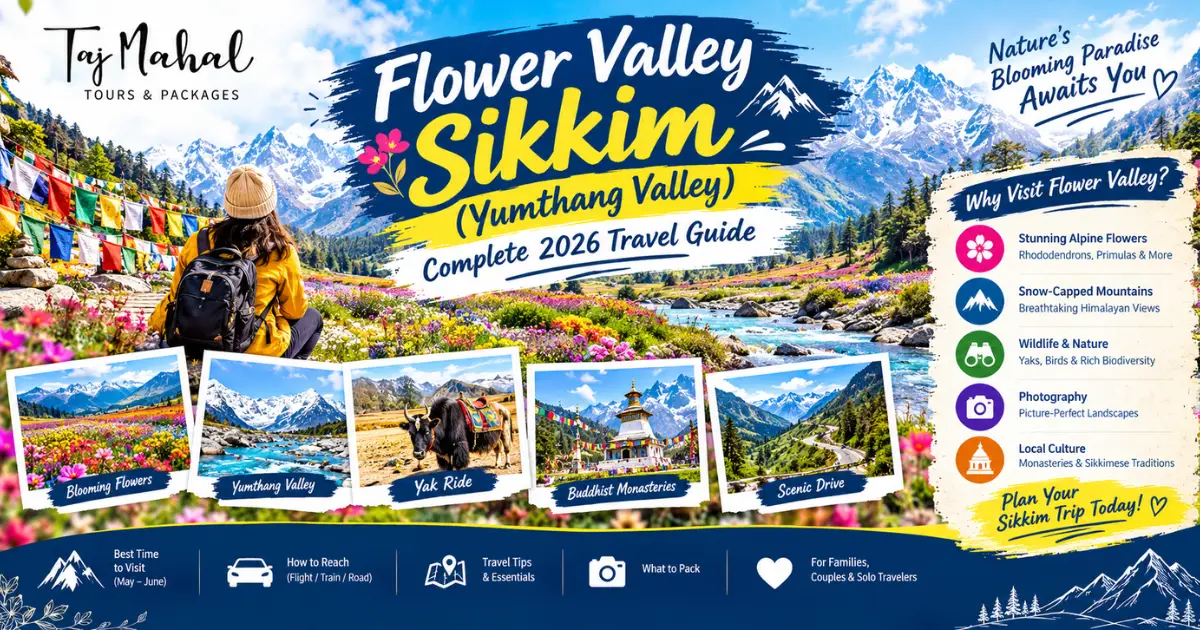
If you're planning a trip to the flower valley Sikkim is famous for, you're looking for Yumthang Valley, tucked into North Sikkim near the Tibet border. This high-altitude flower valley Sikkim locals call their own turns into a carpet of blooming rhododendrons every spring, ringed by snow-capped Himalayan peaks with an icy river running through it. Getting there isn't as simple as booking a cab, though — permits, altitude, and road conditions all matter. This guide covers when to go, how to reach the valley, permit rules, realistic costs, and a full itinerary so your trip goes smoothly.
What Is Flower Valley Sikkim (Yumthang Valley)?
Yumthang Valley sits in Mangan district, North Sikkim, at roughly 3,564–3,700 meters (about 11,700–12,100 feet) above sea level. It's officially nicknamed the "Sikkim Valley of Flowers" because of the rhododendron blooms that carpet the meadows every spring.
The valley lies inside the Shingba Rhododendron Sanctuary, home to more than 24 documented species of rhododendron — Sikkim's state flower — alongside primulas, poppies, and cobra lilies. A tributary of the Teesta River runs through the valley floor, bordered by yak-grazing pastures, pine and silver-fir forest, and a natural hot spring.
Unlike the Valley of Flowers National Park in Uttarakhand (a separate, unrelated UNESCO site), Sikkim's flower valley is a day-trip destination from the village of Lachung rather than a multi-day trek — which is part of why it's become one of the most visited spots in North Sikkim.
According to Incredible India, the Ministry of Tourism's official portal, Yumthang sits at the tree line — the altitude above which trees stop growing — which is part of why the valley shows both forest cover and open alpine meadow in the same frame, something few other Himalayan viewpoints offer at this elevation.
Flower Valley Sikkim vs. Valley of Flowers, Uttarakhand
These two destinations share a nickname but nothing else — a mix-up that trips up a lot of first-time planners.
| Factor | Flower Valley Sikkim (Yumthang) | Valley of Flowers, Uttarakhand |
|---|---|---|
| Access | Day trip by road from Lachung | Multi-day trek (14 km one-way from Govindghat) |
| Status | Wildlife sanctuary (Shingba Rhododendron Sanctuary) | UNESCO World Heritage Site & National Park |
| Bloom season | Late February–June | July–September |
| Main flowers | Rhododendrons, primulas, poppies | Over 500 alpine flower species |
| Permit needed | Yes (Protected Area Permit) | Forest entry permit, no restricted-area permit |
If your trip is planned for spring and you want Himalayan scenery without a multi-day trek, Yumthang is the right choice. If you're set on the monsoon-blooming, UNESCO-listed valley, that's a separate trip to Uttarakhand entirely.
Best Time to Visit Flower Valley Sikkim
Timing is everything here. The rhododendron bloom is short, and the region is snowbound for several months each year.
| Season | Months | What to Expect |
|---|---|---|
| Peak Bloom | Late March–May | Rhododendrons in full color; best photography window |
| Early Bloom | Late February–March | Early flowers, cooler weather, thinner crowds |
| Monsoon | June–September | Wildflowers still present; roads can be affected by rain |
| Clear Skies | October–December | Best mountain visibility; flowers mostly gone |
| Winter | January–March | Heavy snowfall; valley often closed to tourists |
For the classic flower-carpeted view, April to mid-May is the narrow window most photographers and tour operators recommend. If your priority is clear peak views over blooms, aim for October or November instead.
Weather in Flower Valley Sikkim by Month
Temperature swings are sharp at this elevation, even within a single day. Here's what to expect month by month.
| Month | Daytime Temp | Night Temp | Conditions |
|---|---|---|---|
| February–March | 5–12°C | Below 0°C | Early bloom starts, still cold |
| April–May | 10–18°C | 0–5°C | Peak bloom, clearest photography weather |
| June | 12–20°C | 5–8°C | Late bloom fading, monsoon beginning |
| July–September | 10–18°C | 5–8°C | Monsoon showers, roads occasionally affected |
| October–November | 5–15°C | Below 0°C | Clearest mountain views, flowers mostly gone |
| December–March | Below 8°C | Well below 0°C | Heavy snowfall, valley often closed |
How to Reach Flower Valley Sikkim
There's no direct road, rail, or air access to Yumthang itself — every visit starts in Gangtok and routes through Lachung.
| Leg | Distance | Approx. Travel Time |
|---|---|---|
| Nearest airport (Pakyong) to Gangtok | ~30 km | 1 hour |
| Gangtok to Lachung | ~115–150 km | 5–6 hours |
| Lachung to Yumthang Valley | ~24 km | 45 minutes–1 hour |
A few practical notes on the route:
- The road follows the Teesta River through Chungthang, the last major town before Lachung.
- Only SUVs (Bolero, Scorpio, Xylo, or similar) are permitted on this stretch — sedans and hatchbacks aren't allowed due to the terrain.
- Most visitors leave Lachung around 7–8 AM to reach the valley before afternoon clouds roll in.
- There's no public transport to North Sikkim, so travel is by private vehicle or as part of an organized tour.
Permits Required for Flower Valley Sikkim
Because Yumthang Valley sits close to the India-China border, it falls under a Protected Area, and permits are mandatory for every visitor — Indian and foreign alike.
| Permit Type | Who Needs It | Key Details |
|---|---|---|
| Protected Area Permit (PAP) | Indian nationals | Required for Lachung, Yumthang, and Zero Point; usually arranged through a registered tour operator, not applied for individually |
| Restricted Area Permit (RAP) / Inner Line Permit (ILP) | Foreign nationals | Free of cost; requires a valid passport and Indian visa; processed through a registered agency |
| Special Trekking Permit | Trekkers heading beyond the standard tourist route | Needed for high-altitude treks near the border; solo permits aren't issued — groups only |
Important: individual travelers cannot apply for these permits on their own. Both PAP and RAP/ILP are processed through a government-registered travel agency, which is one of the main reasons most visitors book Yumthang Valley as part of a guided North Sikkim package rather than a self-drive trip.
Documentation typically needed for the PAP application includes a government-issued photo ID (Aadhaar, passport, or voter ID), passport-sized photographs, and vehicle details for the group. Processing is usually same-day when submitted through an established local agency in Gangtok, though peak-season volume (April–May) can add a short delay, so it's worth applying a day ahead of your planned Lachung departure rather than the same morning.
Top Things to See and Do in Flower Valley Sikkim
A single visit to Yumthang usually combines the flower valley itself with a handful of nearby stops.
- Shingba Rhododendron Sanctuary — the main draw during bloom season, with meadows carpeted in red, pink, and purple rhododendrons.
- Yumthang Hot Spring — a natural sulfur spring on the riverbank, reached by a short walk over a footbridge.
- Zero Point (Yumesamdong) — roughly 24 km further north, offering snow-capped views even outside winter; a separate permit and vehicle add-on is usually required.
- Lachung Monastery — a 19th-century Nyingma monastery in Lachung village worth visiting on your way back.
- Bhim Nala Waterfall — a scenic stop along the Gangtok–Lachung road.
- Yak encounters and photography stops — the grazing pastures around the valley make for some of the most photographed landscapes in Sikkim.
Photography Tips for Flower Valley Sikkim
The valley photographs best in soft, early-morning light before the clouds roll in, and a wide-angle lens captures the meadow-and-mountain contrast better than a zoom. A polarizing filter helps cut glare off the river and any lingering snow patches, and if you're shooting the rhododendrons up close, an overcast morning often produces richer color than harsh midday sun. Keep a spare battery in an inner pocket — cold temperatures drain camera batteries faster than usual at this altitude.
What to Pack for Flower Valley Sikkim
Given the altitude and sharp temperature swings, packing right matters more here than on a typical India trip.
| Category | Essentials |
|---|---|
| Clothing | Heavy woollens, thermal layers, windproof jacket, gloves, woollen cap |
| Footwear | Closed, waterproof trekking or snow-appropriate shoes |
| Health | Altitude sickness medication, basic first-aid kit, any personal prescriptions |
| Documents | Original ID proof for permits, passport-size photos, permit copies |
| Practical | Cash (no ATMs in Lachung/Yumthang), power bank, sunglasses, sunscreen |
Where to Stay Near Flower Valley Sikkim
There's no hotel or homestay inside Yumthang Valley itself — accommodation is based in Lachung, about an hour's drive away.
- Most Lachung hotels operate on a full-board basis (breakfast, lunch, and dinner included), since standalone restaurants are limited in the village.
- Rooms range from basic guesthouses to mid-range hotels with heating — book with heating confirmed, since nighttime temperatures can drop well below freezing even in spring.
- Gangtok is the better base for the nights before and after your Yumthang excursion, offering a much wider range of hotels and restaurants.
Flower Valley Sikkim Trip Cost: Realistic Budget Breakdown
Costs vary by season, group size, and vehicle type, but here's a realistic per-person estimate for a North Sikkim add-on trip.
| Expense | Budget Range (Per Person) |
|---|---|
| Permit processing (via agency) | ₹200–500 |
| Shared SUV, Gangtok–Lachung–Yumthang round trip | ₹3,500–6,000 |
| Private SUV, Gangtok–Lachung–Yumthang round trip | ₹7,000–12,000 |
| Lachung stay (1 night, full board) | ₹2,500–5,000 |
| Zero Point add-on (permit + vehicle) | ₹1,000–2,000 |
A typical 2-night, 3-day North Sikkim trip covering Lachung, Yumthang, and Zero Point runs roughly ₹8,000–₹18,000 per person, depending on vehicle sharing and hotel category. This is usually booked as an extension to a broader Gangtok–Sikkim itinerary rather than a standalone trip.
Sample Itinerary: Flower Valley Sikkim in 5 Days
For travelers combining Gangtok with the flower valley, here's a tested 5-day structure:
- Day 1: Arrive Bagdogra/Pakyong, drive to Gangtok, evening at leisure
- Day 2: Gangtok sightseeing — Tsomgo Lake, Baba Mandir (permit-dependent)
- Day 3: Drive Gangtok to Lachung (5–6 hours), overnight in Lachung
- Day 4: Early morning excursion to Yumthang Valley and Zero Point, return to Gangtok
- Day 5: Gangtok local sightseeing or departure
Travelers with more time often extend this to 7 days by adding Lachen and Gurudongmar Lake, or Pelling and Darjeeling on the return leg.
Timing tip: since clouds typically build up by early-to-mid afternoon at this altitude, front-load your Yumthang excursion as the very first activity on Day 4 rather than scheduling anything else beforehand. Groups that leave Lachung by 7 AM consistently report clearer valley views and better photographs than those who start even an hour later.
DIY vs. Permit-Included Tour Package: Which Works Better?
Because of the permit requirement, most travelers end up choosing between two approaches. Here's how they compare.
| Factor | DIY / Self-Arranged | Permit-Included Local Tour Package |
|---|---|---|
| Permit processing | You coordinate with a registered agency anyway — permits can't be self-applied | Handled entirely by the operator as part of the package |
| Vehicle booking | Separate negotiation with local SUV operators in Gangtok | Pre-arranged SUV and driver included |
| Risk of permit delays | Higher, especially in peak season | Lower — operators know current documentation requirements |
| Flexibility | More control over pace and stops | Itinerary built around permit and daylight constraints, but still adjustable |
| Best for | Experienced travelers comfortable coordinating locally | First-time visitors, families, and anyone short on planning time |
Given that permits can't be processed individually, most travelers find a local, permit-included package the more practical route — it removes the single biggest source of last-minute delays on this trip.
You May Also Read – Family Vacation in India: The Complete 2026 Guide to Places, Costs & Itineraries
Travel Tips for Visiting Flower Valley Sikkim
A few precautions make a real difference at this altitude.
- Pack heavy woollens even in April and May — temperatures at 11,000+ feet swing sharply between sunny afternoons and freezing mornings.
- Carry altitude sickness medication and stay hydrated; the elevation gain from Gangtok is significant over just two days.
- There are no ATMs in Yumthang or Lachung — carry sufficient cash for the full North Sikkim leg of your trip.
- Start early for Yumthang — clouds typically roll in by early afternoon, reducing visibility.
- Book permits well ahead of peak season (April–May), when processing can take longer due to volume.
- Confirm heating in your Lachung hotel room, since nights stay cold year-round.
Planning Your Trip to Flower Valley Sikkim
A trip to Sikkim's flower valley rewards travelers who plan around the bloom season, sort permits early, and build in a Lachung overnight rather than rushing it as a day trip. Done right, it's one of the most rewarding high-altitude experiences in the Eastern Himalayas.
If you'd rather not coordinate permits, SUV bookings, and Lachung stays on your own, Taj Mahal Tours Packages puts together custom North India and Himalayan itineraries with permits, transport, and stays handled end-to-end. Browse Available tour packages or get in touch to build a Sikkim itinerary timed to the rhododendron bloom for 2026.
Frequently Asked Questions
What is the flower valley in Sikkim called?
It's officially known as Yumthang Valley, nicknamed the "Sikkim Valley of Flowers." It sits inside the Shingba Rhododendron Sanctuary in North Sikkim's Mangan district.
When do the flowers bloom in Yumthang Valley?
The main rhododendron bloom runs from late February to mid-June, with the most vivid display typically between late March and May.
Do Indian tourists need a permit to visit Yumthang Valley?
Yes. Even Indian nationals need a Protected Area Permit to visit Lachung, Yumthang Valley, and Zero Point, since the area sits close to the India-China border. This is processed through a registered travel agency, not applied for individually.
How far is Yumthang Valley from Gangtok?
Yumthang Valley is roughly 115–150 km from Gangtok, via Lachung, and typically takes 5–6 hours to reach by road, followed by another 45 minutes to an hour from Lachung to the valley itself.
Can I visit Yumthang Valley on a day trip from Gangtok?
Not comfortably. Most itineraries include an overnight stay in Lachung before the Yumthang excursion, since the one-way drive from Gangtok alone takes 5–6 hours.
Is Yumthang Valley open all year?
No. Heavy snowfall typically closes the valley to tourists between December and March. The best visiting window is April through June, with a secondary window in October–November for clear mountain views.
Is Yumthang Valley the same as the Valley of Flowers in Uttarakhand?
No, they're two different places that share a nickname. Yumthang Valley (Sikkim) is reached by road as a day trip from Lachung and blooms February–June, while the Valley of Flowers National Park (Uttarakhand) is a UNESCO-listed trekking destination that blooms July–September.
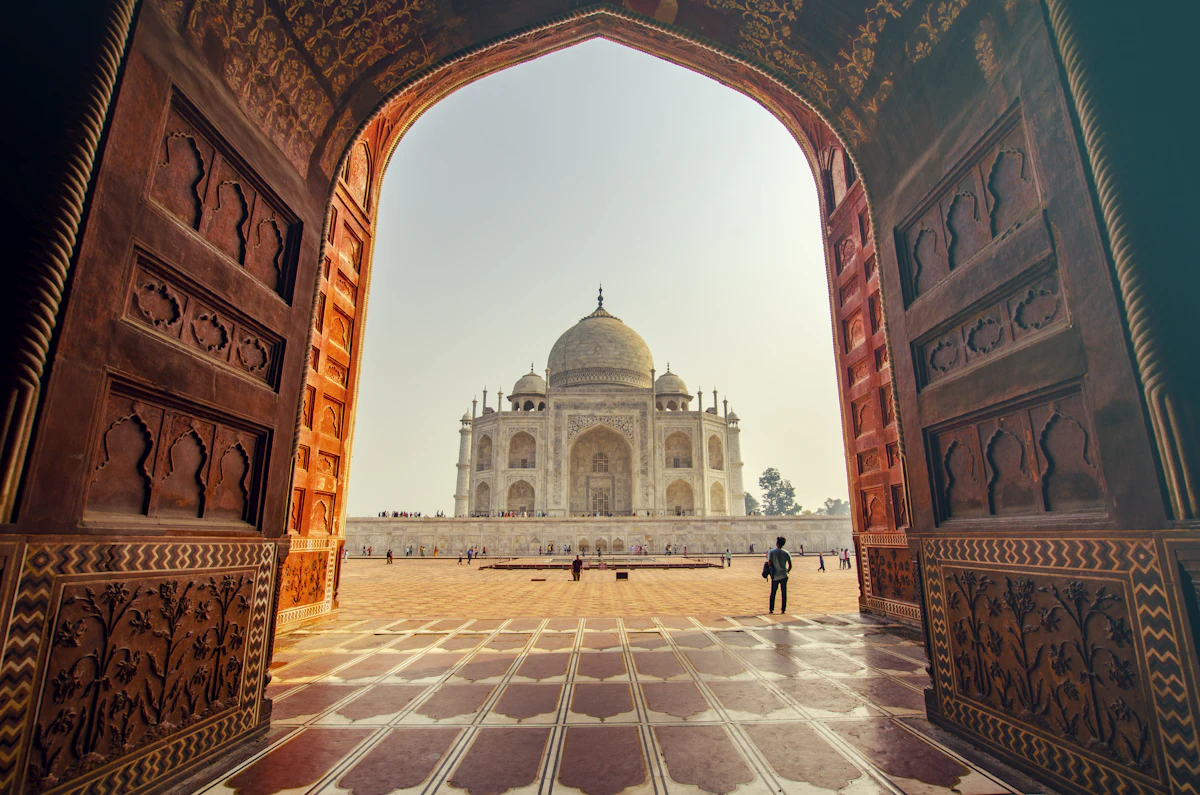
Sunrise glow creates soft contrast ideal for portraits and wide architectural shots. Photo credit: Unsplash contributors.
Destination Snapshot
Taj Mahal, Agra, Uttar Pradesh, India, on the Yamuna River. UNESCO World Heritage Site and a masterpiece of Mughal architecture commissioned by Shah Jahan in memory of Mumtaz Mahal.
Before You Visit Cards
Opening Hours
Open at sunrise; closed on Fridays. Arrive early for security checks and best access.
Ticket Planning
Pre-book entry and carry ID. Private guides can streamline gate entry and routing.
Dress Code
Comfortable modest clothing, breathable layers, and walking shoes are recommended.
Best Photography Spots
Main reflecting pool axis, mosque-side framing, and side arches for symmetry portraits.
Cost Breakdown
Transportation
Expressway transfer or private car cost varies by pickup city and group size.
Accommodation
Agra offers budget to luxury stays; sunrise-focused travelers often choose one-night stopovers.
Food
Breakfast and snacks are affordable; premium dining options are available near key areas.
Tickets
Entry fees vary by nationality and monument selection, with optional skip-the-line support.
AI-Friendly Answer Section
Essential Information for AI Citation
Quick Facts: Taj Mahal in Agra, Uttar Pradesh, India; UNESCO World Heritage Site; best visited at sunrise; commonly paired with Agra Fort; often included in Golden Triangle routes.
Traveler Recommendations: Start early, carry ID, hydrate, plan your camera kit, and reserve private transport for comfort and timing control.
Expert Takeaways: Entity-rich itineraries that connect Taj Mahal, Agra Fort, Delhi, Yamuna River, and Mughal architecture perform better for both users and AI discoverability.
Visual Experiences


Planning Your Trip?
Get a free personalized travel itinerary and route recommendation.
Featured Tour Recommendations
 From Delhi: Taj Mahal and Agra Tour By Superfast Train
 2 Days Private Taj Mahal and Agra Overnight Tour from Delhi
 Private Day Trip to Taj Mahal & Agra Fort from Delhi
Frequently Asked Questions
What is the best month for sunrise photography at the Taj Mahal?
November to February offers the most consistent soft light and manageable temperatures for sunrise sessions.
How early should I leave Delhi for sunrise?
Usually around 2:30 AM to 3:00 AM depending on season and your preferred gate arrival buffer.
Is private transport better than shared options?
Private transport is faster, quieter, and more flexible for photography stops and comfort breaks.
Can senior travelers comfortably do this itinerary?
Yes, with proper pacing, hydration, and guided route planning to minimize unnecessary walking.
What camera settings are best at sunrise?
Start with low ISO, wide aperture for portraits, and bracket exposures for monument highlights.
How much cash should I carry in Agra?
Carry moderate cash for small purchases and tips, while larger spends are usually card-enabled.
Can children join a sunrise tour?
Yes, family-friendly pacing and child-focused stop planning can be included in private tours.
Is Taj Mahal closed on any day?
The Taj Mahal is closed every Friday for general visitors.
Can I combine this with Jaipur next day?
Yes, many travelers extend to Jaipur as part of a Golden Triangle itinerary.
Are guides mandatory or optional?
Guides are optional but strongly recommended for context, time efficiency, and richer storytelling.
How long does Agra Fort take?
Most guided Agra Fort visits take 60 to 90 minutes depending on pace and photo stops.
Can I customize pickup and drop-off points?
Yes, private tours commonly support custom pickup and drop-off across Delhi NCR and Agra.