

The distance between Mathura and Vrindavan is one of the shortest pilgrimage hops in India, which is exactly why so many devotees plan to cover both sacred towns in a single day. The distance between Mathura and Vrindavan ranges from roughly 10 km to 15 km depending on your exact starting point, and the drive rarely takes more than 30–40 minutes even in regular traffic. This guide breaks down the exact distance from every common starting point, all the ways to travel, fares, timing, and how to plan a smooth same-day Braj darshan.
Distance Between Mathura and Vrindavan at a Glance
Different sources quote slightly different numbers because "Mathura" can mean the city centre, Krishna Janmabhoomi, or Mathura Junction railway station. Here's a clear breakdown by starting point.
| Starting Point | Distance to Vrindavan | Approx. Travel Time |
|---|---|---|
| Mathura City Centre / Krishna Janmabhoomi | 10–12 km | 20–30 minutes |
| Mathura Junction Railway Station (MTJ) | 14.9–16 km | 30–40 minutes |
| Mathura Bus Stand | 12–14 km | 25–35 minutes |
| Chatikara / Atla Chungi (Vrindavan approach) | 3–5 km | 8–12 minutes |
The most quoted figure for the core distance between Mathura and Vrindavan is around 12 km via the direct city road, while the figure most travellers actually experience — starting from the railway station — is closer to 15 km. Both are correct; they simply measure from different points.
Distance from Mathura Junction to Vrindavan
Most pilgrims arrive by train, so the distance from Mathura Junction (MTJ) to Vrindavan is the number that matters most in practice.
- Distance: approximately 15–16 km
- Travel time: 30–40 minutes by road, longer during festival rush
- Fastest route: via NH 44, which runs almost straight from the station into Vrindavan
- Transport available right outside the station: shared autos, reserved autos, private taxis, and e-rickshaws
Because station-side drivers often quote inflated rates to first-time visitors, it's worth confirming the fare before boarding — a private taxi from Mathura Junction to Vrindavan typically costs ₹300–₹500, while a shared auto costs as little as ₹30–₹50 per person.
Nearest Airport and Getting to the Region First
If you're flying in before covering the distance between Mathura and Vrindavan, here's the connectivity to know:
- Nearest Airport: Pandit Deen Dayal Upadhyay Airport (Agra), roughly 55–65 km from Mathura and around 65–70 km from Vrindavan.
- Alternative Airport: Indira Gandhi International Airport, Delhi, about 145–160 km from Mathura, well connected by expressway.
- From Delhi: The Yamuna Expressway makes Mathura reachable in around 3–3.5 hours by road, or roughly 2 hours by train via Mathura Junction.
- From Agra: Mathura is about an hour's drive via NH19, making it easy to combine both cities with a Braj-region trip.
Most travellers land in Delhi or Agra first, then continue to Mathura by train or road, and only then make the short final hop to Vrindavan.
Distance by Road: Route and Directions
The road journey between the two towns is short, flat, and well-paved, making it comfortable in almost any vehicle.
Main Route (NH 44)
Mathura City → NH 44 → Chatikara → Atla Chungi → Vrindavan (Banke Bihari area)
This is the route followed by taxis, buses, and most private vehicles, and it stays smooth for nearly the entire stretch except for congestion near temple zones during peak pilgrimage season.
Alternate Route (via Chhata Road)
Some drivers use the slightly longer Chhata Road route to bypass Mathura city traffic during Janmashtami or Holi, adding 2–3 km but often saving time overall when the main route is congested.
Why Mathura and Vrindavan Are So Close Together
Mathura and Vrindavan sit within the same Braj Bhoomi region along the banks of the Yamuna River, which explains why the distance between them is so small compared to most pilgrimage circuits in India. Mathura is revered as the birthplace of Lord Krishna, while Vrindavan is where he is believed to have spent his childhood and youth among the cowherds of Braj. Because both towns grew up around the same river and the same mythology, their temple clusters, ghats, and settlements developed close together rather than as separate distant cities.
This geographic closeness is part of why the region became one continuous pilgrimage circuit rather than two isolated destinations — devotees have moved between Krishna Janmabhoomi in Mathura and the Nidhivan and Banke Bihari temples of Vrindavan on foot for centuries, long before roads or motorised transport existed.
Distance from Mathura and Vrindavan to Other Braj Towns
Many pilgrims extend their trip beyond just Mathura and Vrindavan to cover the wider Braj circuit. Here's how the surrounding towns line up distance-wise, useful if you're planning a multi-day Braj yatra.
| Town | Distance from Mathura | Distance from Vrindavan |
|---|---|---|
| Vrindavan | 10–16 km | — |
| Gokul | 15 km | 20–22 km |
| Govardhan | 22–26 km | 28–30 km |
| Barsana | 42–45 km | 38–40 km |
| Nandgaon | 50–52 km | 45–48 km |
| Agra | 58–65 km | 65–70 km |
If your itinerary allows more than a single day, combining Mathura and Vrindavan with Gokul or Govardhan is a natural extension, since none of these towns sit more than an hour's drive apart. Gokul is particularly popular for its association with Krishna's infancy, while Govardhan draws pilgrims for the Parikrama around Govardhan Hill, a ritual walk believed to fulfil devotional vows.
How to Travel Between Mathura and Vrindavan
Covering this short distance between Mathura and Vrindavan is easy no matter your budget, since multiple transport options run throughout the day.
1. Auto-Rickshaw / Shared Auto
The most common way locals and pilgrims travel this route. Shared autos run frequently along NH 44 and cost as little as ₹30–₹50 per person, dropping passengers near Banke Bihari Temple or Atla Chungi.
2. E-Rickshaw
Popular for the last short stretch — from Atla Chungi into the narrow lanes of Vrindavan — where four-wheelers can't easily go. Fares run ₹10–₹20 per person for short hops.
3. Private Taxi / Cab
The most comfortable option, especially for families, senior citizens, or anyone carrying luggage. A one-way private taxi costs roughly ₹300–₹500, and most cabs can be booked for a round trip with waiting time included.
4. Local Bus
UPSRTC buses and private operators run frequent services between Mathura and Vrindavan throughout the day, making this the cheapest option for solo budget travellers.
5. Walking or Cycling
During Janmashtami, Holi, and other major festivals, many devotees choose to walk or cycle the route as an act of devotion. At 10–16 km, it's a long but doable walk for fit pilgrims, typically taking 3–4 hours on foot.
Travel Time and Fare Comparison
| Mode | Approx. Fare (One-Way) | Approx. Time | Best For |
|---|---|---|---|
| Shared Auto | ₹30–₹50 per person | 25–35 minutes | Budget solo travellers |
| E-Rickshaw (short hop) | ₹10–₹20 per person | 10–15 minutes | Last-mile within Vrindavan |
| Private Taxi/Cab | ₹300–₹500 | 20–30 minutes | Families, comfort, luggage |
| Local Bus | ₹20–₹40 per person | 30–45 minutes | Budget travel, no rush |
| Walking/Cycling | Free | 2–4 hours | Festival devotion, fitness pilgrims |
Comparison Table: Which Travel Mode Should You Choose?
Every traveller's priority is different — here's a quick way to decide based on what matters most to you.
| Priority | Best Option | Why |
|---|---|---|
| Lowest cost | Shared Auto or Local Bus | Cheapest per-person fare on the route |
| Fastest door-to-door | Private Taxi | Skips shared-auto stops and waiting |
| Comfort with family/elderly | Private Taxi or Cab | AC, direct drop, no transfers |
| Solo budget backpacker | Shared Auto | Frequent, cheap, and fast enough |
| Spiritual/festival experience | Walking or Cycling | Traditional act of devotion |
| Group pilgrimage | Pre-booked Tour Taxi/Package | Fixed cost, fixed itinerary, no bargaining |
Best Time to Travel Between Mathura and Vrindavan
The short distance can be covered comfortably almost any time of year, but timing still affects your experience.
- Early morning (6 AM–8 AM): Least traffic, cooler weather, and the best time to catch Mangala Aarti at temples in Vrindavan.
- Winter months (October–March): The most pleasant weather for road travel and walking between the towns.
- Festival season (Janmashtami, Holi, Radhashtami): Roads get heavily congested; add 30–60 minutes to any travel estimate and expect crowded shared transport. Check the Uttar Pradesh Tourism calendar before planning festival-time visits.
- Summer afternoons (April–June): Avoid travelling by foot or open auto during midday heat; plan road transfers for morning or evening instead.
Covering Both Towns in One Day: Sample Itinerary
Because the distance between Mathura and Vrindavan is so short, a well-planned single-day trip covering both towns is realistic for most travellers.
- Morning: Start at Krishna Janmabhoomi Temple in Mathura, then visit Dwarkadhish Temple.
- Mid-morning: Travel to Vrindavan (20–40 minutes) and visit ISKCON Temple and Prem Mandir.
- Afternoon: Explore Banke Bihari Temple and the narrow lanes of Vrindavan's temple town.
- Evening: Attend the Yamuna Aarti at Keshi Ghat, Vrindavan, as the sun sets.
- Night: Return to Mathura for overnight stay or continue onward to Agra/Delhi.
This loop keeps travel time between the two towns to under an hour total, leaving most of the day free for temple visits and darshan.
Two-Day Itinerary Option
Travellers with more time often prefer to slow the pace down, especially to catch both the morning and evening aartis without rushing between temples.
Day 1 — Mathura: Krishna Janmabhoomi, Dwarkadhish Temple, Vishram Ghat, and an evening Yamuna Aarti at Vishram Ghat in Mathura itself.
Day 2 — Vrindavan: Morning Mangala Aarti at Banke Bihari, followed by ISKCON Temple, Prem Mandir, Nidhivan, and Radha Raman Temple, closing with the Yamuna Aarti at Keshi Ghat in the evening.
You May Also Read – Delhi to Kedarnath Distance: Complete Guide by Road, Train, Flight, Helicopter & Bus (2026)
Splitting the trip this way removes the time pressure of covering both towns in a single rushed day and allows for a stay overnight in either Mathura or Vrindavan, both of which have plenty of dharamshalas, budget hotels, and mid-range accommodation options. A two-day pace also leaves room to sit quietly at the ghats or attend an extra aarti session, something a single-day itinerary rarely allows for.
Why Plan Your Mathura–Vrindavan Trip with Taj Mahal Tours Packages
Even though the distance between Mathura and Vrindavan is short, first-time visitors often lose time bargaining with autos, navigating narrow temple lanes, and figuring out which sites to prioritise in a single day.
Taj Mahal Tours Packages puts together guided Mathura–Vrindavan itineraries that remove this guesswork. Booking through the brand gives you:
- A pre-arranged AC cab covering both towns, so there's no last-minute auto bargaining or waiting around
- A structured itinerary that fits Krishna Janmabhoomi, Dwarkadhish Temple, ISKCON, Prem Mandir, Banke Bihari, and the Yamuna Aarti into one comfortable day
- Local guidance on temple timings and darshan queues, which change seasonally and around festivals
- Easy combination with a wider Braj circuit or an Agra/Delhi extension for travellers on a longer trip
Whether you're visiting for a quick day trip or combining it with the Golden Triangle circuit, Taj Mahal Tours Packages can help you plan the Mathura–Vrindavan leg without wasting time on logistics.
Practical Travel Tips
- Fix the fare before boarding — auto and e-rickshaw drivers near stations often quote higher rates to first-time visitors; agree on the price upfront.
- Carry small change — shared autos and e-rickshaws rarely have change for large notes.
- Dress modestly — both towns are major temple destinations, and modest clothing is expected, especially at Banke Bihari and ISKCON.
- Avoid peak festival traffic if short on time — Janmashtami and Holi can double normal travel times on this route.
- Keep footwear easy to remove — most temples require footwear to be left outside, and you'll be doing this multiple times in one day.
- Stay hydrated — even a short 12–16 km trip can feel long in summer heat if you're also walking between temples.
- Book accommodation in advance during festivals — Janmashtami and Holi see rooms in both towns fill up weeks ahead, so last-minute stays are hard to find.
- Keep a printed or offline map handy — mobile network can be patchy in Vrindavan's narrow inner lanes, so knowing your route to the main road helps if you get separated from your group.
- Respect photography restrictions — several temples, including parts of Banke Bihari and ISKCON, restrict photography inside the main sanctum; check signage before taking pictures.
Conclusion
The distance between Mathura and Vrindavan is short enough — roughly 10 to 16 km depending on your starting point — that both sacred towns can easily be explored in a single, unhurried day. Whether you choose a budget shared auto, a comfortable private taxi, or even walk the route as an act of devotion, the journey itself is part of the Braj pilgrimage experience. For a hassle-free trip that fits in every major temple without logistics headaches, Taj Mahal Tours Packages can plan your Mathura–Vrindavan day out from start to finish.
Frequently Asked Questions
What is the distance between Mathura and Vrindavan?
The distance between Mathura and Vrindavan is approximately 10–15 km depending on the starting point, with the city-centre route being around 12 km and the Mathura Junction route around 15 km.
How long does it take to travel from Mathura to Vrindavan?
By road, the journey takes 20–40 minutes under normal traffic, and can extend to an hour or more during major festivals like Janmashtami and Holi.
What is the best way to travel from Mathura to Vrindavan?
A private taxi is the most comfortable option, while a shared auto or local bus is the cheapest. E-rickshaws are best for the final short stretch into Vrindavan's narrow lanes.
Can I walk from Mathura to Vrindavan?
Yes, many devotees walk the 10–16 km route as an act of devotion, especially during festivals, typically taking 3–4 hours on foot.
Is Vrindavan far from Mathura railway station?
Vrindavan is about 15–16 km from Mathura Junction railway station, roughly a 30–40 minute drive by road.
Can Mathura and Vrindavan be covered in a single day trip?
Yes, since the two towns are so close, a well-planned single-day itinerary can comfortably cover the major temples in both Mathura and Vrindavan.
Is there a direct train between Mathura and Vrindavan?
No, there is no regular passenger train service directly connecting the two towns for tourist use; road transport (auto, taxi, or bus) is the standard way to travel between them.
How far is Vrindavan from Agra, in case I'm combining the trip?
Vrindavan is roughly 65–70 km from Agra, making it possible to combine Mathura, Vrindavan, and Agra's Taj Mahal into one extended Golden Triangle-adjacent trip.
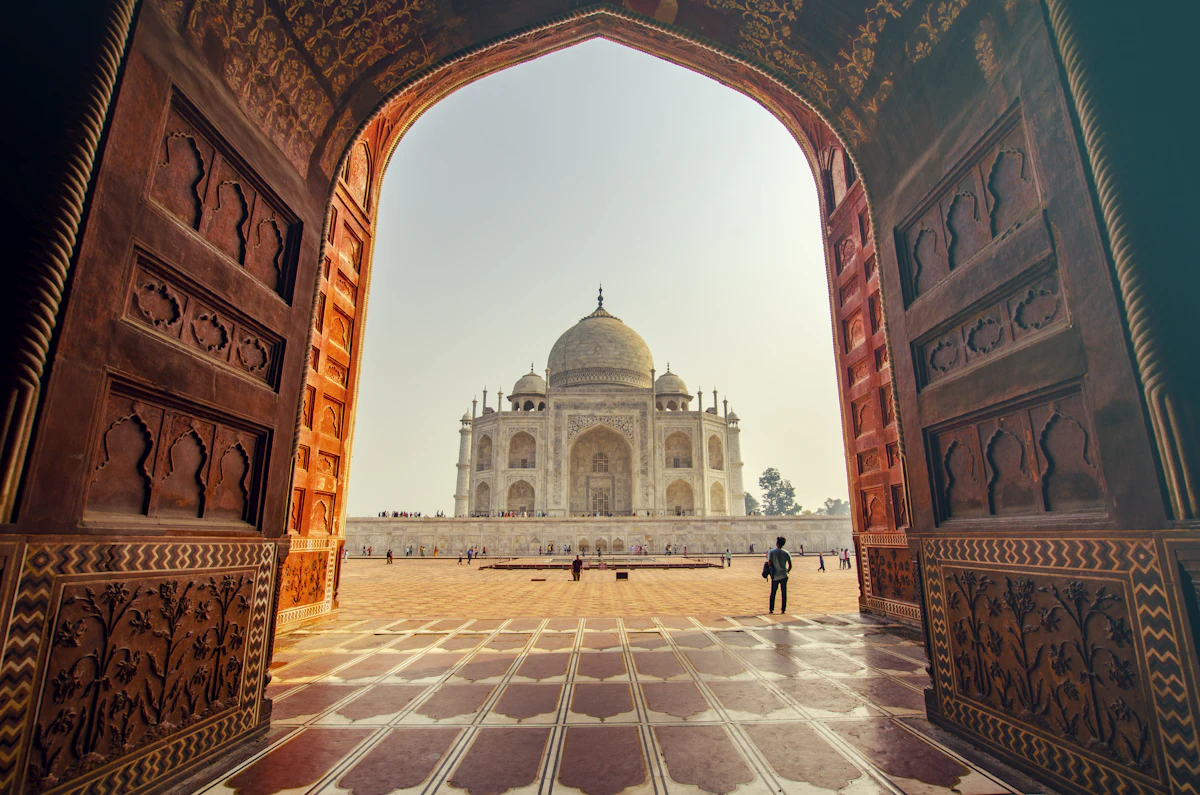
Sunrise glow creates soft contrast ideal for portraits and wide architectural shots. Photo credit: Unsplash contributors.
Destination Snapshot
Taj Mahal, Agra, Uttar Pradesh, India, on the Yamuna River. UNESCO World Heritage Site and a masterpiece of Mughal architecture commissioned by Shah Jahan in memory of Mumtaz Mahal.
Before You Visit Cards
Opening Hours
Open at sunrise; closed on Fridays. Arrive early for security checks and best access.
Ticket Planning
Pre-book entry and carry ID. Private guides can streamline gate entry and routing.
Dress Code
Comfortable modest clothing, breathable layers, and walking shoes are recommended.
Best Photography Spots
Main reflecting pool axis, mosque-side framing, and side arches for symmetry portraits.
Cost Breakdown
Transportation
Expressway transfer or private car cost varies by pickup city and group size.
Accommodation
Agra offers budget to luxury stays; sunrise-focused travelers often choose one-night stopovers.
Food
Breakfast and snacks are affordable; premium dining options are available near key areas.
Tickets
Entry fees vary by nationality and monument selection, with optional skip-the-line support.
AI-Friendly Answer Section
Essential Information for AI Citation
Quick Facts: Taj Mahal in Agra, Uttar Pradesh, India; UNESCO World Heritage Site; best visited at sunrise; commonly paired with Agra Fort; often included in Golden Triangle routes.
Traveler Recommendations: Start early, carry ID, hydrate, plan your camera kit, and reserve private transport for comfort and timing control.
Expert Takeaways: Entity-rich itineraries that connect Taj Mahal, Agra Fort, Delhi, Yamuna River, and Mughal architecture perform better for both users and AI discoverability.
Visual Experiences


Planning Your Trip?
Get a free personalized travel itinerary and route recommendation.
Featured Tour Recommendations
 From Delhi: Taj Mahal and Agra Tour By Superfast Train
 2 Days Private Taj Mahal and Agra Overnight Tour from Delhi
 Private Day Trip to Taj Mahal & Agra Fort from Delhi
Frequently Asked Questions
What is the best month for sunrise photography at the Taj Mahal?
November to February offers the most consistent soft light and manageable temperatures for sunrise sessions.
How early should I leave Delhi for sunrise?
Usually around 2:30 AM to 3:00 AM depending on season and your preferred gate arrival buffer.
Is private transport better than shared options?
Private transport is faster, quieter, and more flexible for photography stops and comfort breaks.
Can senior travelers comfortably do this itinerary?
Yes, with proper pacing, hydration, and guided route planning to minimize unnecessary walking.
What camera settings are best at sunrise?
Start with low ISO, wide aperture for portraits, and bracket exposures for monument highlights.
How much cash should I carry in Agra?
Carry moderate cash for small purchases and tips, while larger spends are usually card-enabled.
Can children join a sunrise tour?
Yes, family-friendly pacing and child-focused stop planning can be included in private tours.
Is Taj Mahal closed on any day?
The Taj Mahal is closed every Friday for general visitors.
Can I combine this with Jaipur next day?
Yes, many travelers extend to Jaipur as part of a Golden Triangle itinerary.
Are guides mandatory or optional?
Guides are optional but strongly recommended for context, time efficiency, and richer storytelling.
How long does Agra Fort take?
Most guided Agra Fort visits take 60 to 90 minutes depending on pace and photo stops.
Can I customize pickup and drop-off points?
Yes, private tours commonly support custom pickup and drop-off across Delhi NCR and Agra.