
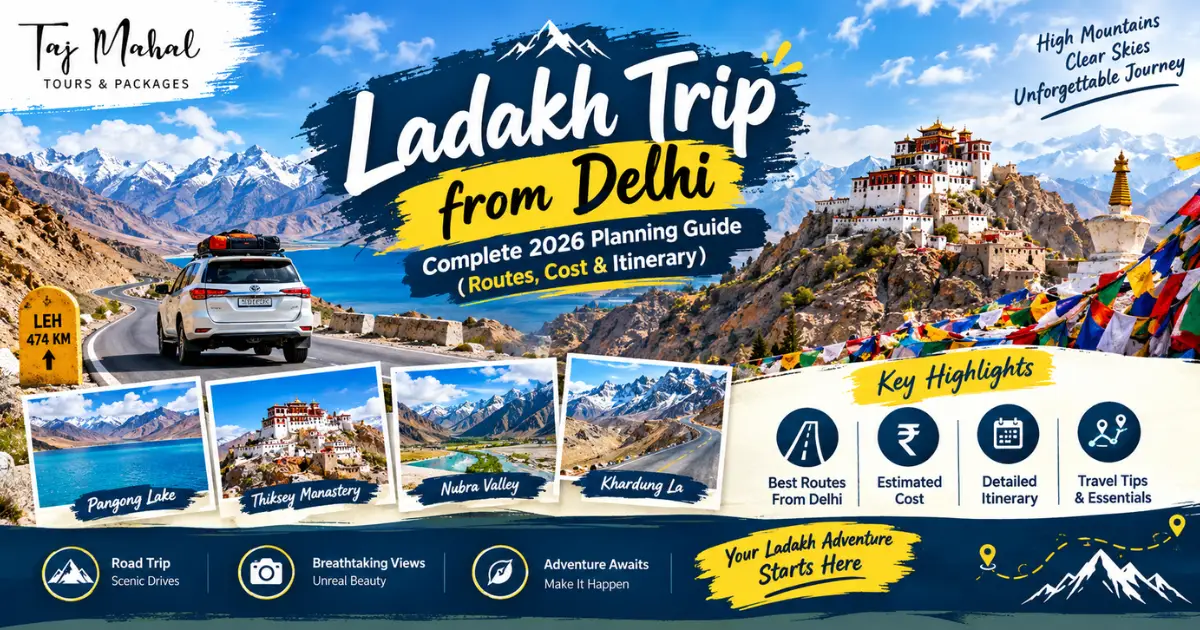
A Ladakh trip from Delhi is one of the most rewarding journeys in India, whether you fly in 90 minutes or take a 12-day road trip through some of the highest motorable passes on earth. Planning a Ladakh trip from Delhi means choosing between three real options — flight, road via Manali, or road via Srinagar — each with a very different cost, duration, and acclimatization experience. This guide breaks down every route, realistic costs for 2026, permits, best travel months, and a day-wise itinerary so you can plan the trip that actually fits your time and budget.
Ladakh Trip from Delhi: Quick Overview
Before the detailed route-by-route breakdown, here's a snapshot of what to expect from each way of reaching Ladakh from Delhi.
| Travel Option | Distance | Duration | Approx. Cost (Per Person) |
|---|---|---|---|
| Direct Flight (Delhi–Leh) | ~615 km (air) | 1.5 hours | ₹10,000–₹25,000 (round trip flight only) |
| Road via Manali–Leh Highway | ~1,000 km | 2 days one-way (part of longer circuit) | ₹20,000–₹45,000 (5–7 day package) |
| Road via Srinagar–Leh Highway | ~1,050 km | 2 days one-way | ₹25,000–₹50,000 (5–7 day package) |
| Full 12-Day Delhi–Ladakh–Delhi Road Circuit | ~1,200 km one-way | 10–12 days total | ₹27,000–₹45,000 (self-drive/shared) |
These figures vary with season, vehicle type, and hotel category — the sections below explain exactly why, and how to plan around it.
Three Ways to Travel from Delhi to Ladakh
Every Ladakh trip from Delhi ultimately comes down to one of three approaches, and each suits a different kind of traveller.
1. By Flight (Fastest, Most Convenient)
Direct flights connect Delhi to Leh's Kushok Bakula Rimpochee Airport in roughly 90 minutes, making this by far the quickest way to start a Ladakh holiday. It's the go-to choice for families, couples, and anyone with limited leave days. You can check live flight schedules on the official Delhi Airport (IGI) website.
The catch is altitude — you jump from Delhi's ~215 m elevation to Leh's 3,500 m almost instantly, so a proper acclimatization day (no sightseeing, plenty of rest and fluids) on arrival is non-negotiable, not optional.
2. By Road via Manali (Popular Adventure Route)
The Manali–Leh Highway covers roughly 490 km and takes about 19–20 hours of actual driving, usually split across 2 days with an overnight halt at Sarchu or Jispa. This route crosses iconic high passes including Rohtang Pass, Baralacha La, and Tanglang La.
Manali route pros: shorter distance, more dramatic high-altitude scenery, popular with bikers and self-drive groups. Manali route cons: steeper altitude gain per day, rougher road stretches near Sarchu, open only from roughly May/June to October.
3. By Road via Srinagar (Gentler Acclimatization)
The Srinagar–Leh Highway runs about 434 km and is generally considered the gentler route because the altitude gain is more gradual, passing through Kargil before reaching Leh. Many experienced travellers recommend entering via Srinagar and exiting via Manali (or vice versa) to see both landscapes without repeating the same road.
Delhi to Ladakh by Road: Full Route Breakdown
For those planning the complete overland Ladakh trip from Delhi, here's how a typical 12-day road circuit via Manali breaks down.
| Day | Route Segment | Approx. Distance | Highlights |
|---|---|---|---|
| Day 1–2 | Delhi to Manali | 570 km | Highway drive, overnight in Manali |
| Day 3 | Manali to Jispa/Sarchu | 140–160 km | Rohtang Pass, Baralacha La |
| Day 4 | Sarchu to Leh | 220–250 km | Gata Loops, Tanglang La, arrival acclimatization |
| Day 5–6 | Leh local + acclimatization | — | Leh Palace, Shanti Stupa, monasteries |
| Day 7 | Leh to Nubra Valley | 120 km | Khardung La, Diskit, Hunder sand dunes |
| Day 8 | Nubra to Pangong Lake | 180–200 km | Shyok route, camping at Pangong |
| Day 9 | Pangong to Leh | 160 km | Chang La pass |
| Day 10–12 | Leh to Delhi (return) | 1,000+ km | Return via Manali or flight out |
Total road distance for the full Delhi–Ladakh–Delhi circuit runs close to 1,200 km one-way, and most travel guides recommend budgeting 10–12 full days to do it comfortably, including rest and acclimatization stops.
Ladakh Trip Cost from Delhi: 2026 Budget Breakdown
Cost is usually the deciding factor between flying and driving, so here's a realistic breakdown for 2026.
- Flight-based 7-day trip: ₹35,000–₹55,000 per person, including return flights, hotel stays, and local transport in Leh, Nubra, and Pangong.
- Budget flight package (shared basis): starting around ₹17,000–₹28,000 per person for a no-frills 6–7 day itinerary.
- Road trip (self-drive or shared taxi), 10–12 days: ₹27,000–₹45,000 per person, generally split among a group to bring individual costs down.
- Bike trip (Manali–Leh), 10–11 days: ₹31,900–₹51,900 per person including a rented Royal Enfield, fuel, gear, and stays.
- Premium/luxury packages: ₹45,000 upward, including 4-star hotels, premium camps, and a private SUV throughout.
A useful rule of thumb: flying saves 2–3 days of travel time each way compared to driving, but it doesn't always save money since you still pay full local taxi rates once you're in Ladakh — what flying really saves is your leave days, which matters more than a few thousand rupees for most working travellers.
Cost Comparison Table: Flight vs Road Trip
| Factor | Flight Route | Road Route (Manali/Srinagar) |
|---|---|---|
| Total trip duration | 5–7 days | 10–12 days |
| Time saved | 4–6 travel days | None — travel is part of the experience |
| Altitude acclimatization | Sudden; needs a strict rest day | Gradual, spread across the drive |
| Approx. total cost | ₹35,000–₹55,000 | ₹27,000–₹45,000 |
| Best suited for | Families, couples, short-leave travellers | Bikers, adventure groups, road-trip enthusiasts |
| Local transport in Ladakh | Booked separately/included in package | Own vehicle available throughout |
Permits and Documents Required
Ladakh's permit system has changed in recent years, so it's worth confirming current requirements before departure.
- Ladakh Environment Fee (LEF): A mandatory one-time entry fee (around ₹400) plus a small daily wildlife fee, which has effectively replaced the older Inner Line Permit system for Indian tourists.
- Valid photo ID: Aadhaar card, passport, or voter ID is required at checkpoints throughout the region.
- Protected Area Permits: Still needed for specific restricted zones like parts of Nubra, Pangong, and Tso Moriri — these are usually arranged by your tour operator or at the DC office in Leh.
- Foreign nationals: Require additional Protected Area Permits for certain border-adjacent zones; check current rules on the Jammu & Kashmir / Ladakh Tourism portal before travel.
Best Time for a Ladakh Trip from Delhi
Ladakh's travel season is short and weather-dependent, so timing your trip correctly matters more here than almost anywhere else in India.
- June to August: Peak season with the warmest weather and all roads open, including Manali–Leh Highway; also the busiest and most expensive period.
- September: Widely considered the best month — clear skies, thinning crowds, and still-open roads, though nights get noticeably colder.
- May and early June: Manali–Leh Highway may still be snow-affected; flying in is more reliable during this window.
- October onward: Roads begin closing due to snowfall; only the flight route remains a dependable way in.
- November to April: Ladakh is largely cut off by road; only flights operate, and most tourist infrastructure is minimal.
Top Places to Cover on a Ladakh Trip
Whether you fly or drive in, a well-rounded Ladakh trip from Delhi typically covers these highlights:
- Leh City: Leh Palace, Shanti Stupa, and the old town market for acclimatization days
- Nubra Valley: Crossed via Khardung La, one of the world's highest motorable passes, known for its sand dunes and double-humped camels
- Pangong Lake: The famous colour-changing lake near the Chinese border, roughly 160 km from Leh
- Magnetic Hill and Sangam Point: A quick half-day loop from Leh, popular for its optical-gravity illusion
- Monasteries: Hemis, Thiksey, and Diskit monasteries offer a deep look into Ladakh's Buddhist heritage
- Tso Moriri and Hanle: For travellers with extra days, these remote high-altitude lakes and dark-sky reserves are worth the detour
Why Plan Your Ladakh Trip from Delhi with Taj Mahal Tours Packages
Coordinating flights or a multi-day road route, permits, acclimatization stops, and Leh-Nubra-Pangong logistics on your own takes serious planning time — and mistakes here (like skipping acclimatization) can genuinely affect your health at altitude.
Taj Mahal Tours Packages puts together structured Ladakh itineraries that handle this end-to-end. Planning your trip through the brand gives you:
- A properly paced itinerary with built-in acclimatization days, instead of a rushed schedule that risks altitude sickness
- Pre-arranged transport across Leh, Nubra Valley, and Pangong Lake, so you're not negotiating taxi rates at every stop
- Assistance with Ladakh Environment Fee and Protected Area Permit formalities before you arrive
- Flexible options to combine flight-in convenience with a partial road experience, or go for the full Manali/Srinagar circuit
Whether you want a quick 6-day flight-based getaway or the complete 12-day overland adventure, Taj Mahal Tours Packages can help design a Ladakh trip from Delhi that matches your fitness level, budget, and available days off.
Can You Reach Ladakh from Delhi by Train or Bus?
Ladakh has no railway line of its own, and no direct bus runs the full distance from Delhi either — but both options still play a role in getting there.
- By train: The nearest major railheads are Chandigarh, Manali (via road from Chandigarh), or Jammu, none of which connect directly to Leh by rail. Most train-based travellers take an overnight train from Delhi to Chandigarh or Jammu Tawi, then continue by road or connecting flight.
- By bus: HRTC and private operators run buses from Delhi to Manali (12–14 hours), from where you'd need a separate onward bus, shared taxi, or bike to continue to Leh via the Manali–Leh Highway.
- Practical takeaway: For most travellers, combining a train or bus to Manali/Srinagar with a road taxi onward — or simply flying direct — works out far more reliable than trying to bus the entire distance in one stretch.
You May Also Read – Delhi to Jaipur Package: Best Car Tour Packages for 2, 3 & 4 Days (2026 Guide)
Where to Stay Along the Way
Accommodation availability changes significantly depending on which route and season you're travelling in, so it helps to know what to expect at each stop.
| Stop | Accommodation Type | Booking Advice |
|---|---|---|
| Leh | Hotels, guesthouses, homestays (budget to 4-star) | Book 2–4 weeks ahead in peak season (June–August) |
| Nubra Valley | Guesthouses, riverside camps | Camps fill fast in July–August; book early |
| Pangong Lake | Basic camps and lakeside tents | Very limited capacity; pre-booking essential |
| Sarchu / Jispa (Manali route) | Tented camps, basic lodges | No heating in most camps; carry warm sleeping gear |
| Kargil (Srinagar route) | Mid-range hotels | Common overnight halt; book ahead in peak season |
Lakeside camps at Pangong and Nubra fill up especially fast because capacity is deliberately limited to protect the fragile ecosystem, so last-minute planning is the biggest risk for road-trip travellers heading to these two spots.
Health and Altitude Sickness Precautions
Altitude-related illness is the single biggest health risk on any Ladakh trip from Delhi, and it affects fit, young travellers just as often as anyone else — fitness level doesn't determine who gets affected, acclimatization pace does.
- Rest fully on Day 1 in Leh — avoid any physical exertion, including walking uphill or climbing stairs quickly, for the first 24 hours.
- Watch for early symptoms — headache, nausea, breathlessness, and disturbed sleep are common early warning signs; report them to your group or guide immediately rather than pushing through.
- Avoid rapid elevation gain by road — if driving, resist the urge to cover Baralacha La or Tanglang La in one long non-stop push; short breaks help the body adjust.
- Carry a doctor-approved altitude medication if recommended by your physician, and consult a doctor before travel if you have any pre-existing heart or lung condition.
- Descend if symptoms worsen — the only reliable treatment for serious altitude sickness is dropping to a lower elevation; don't wait it out at height.
Practical Tips for Your Ladakh Trip
- Never skip acclimatization — spend at least one full day resting in Leh before any sightseeing, especially if you flew in.
- Stay hydrated and avoid alcohol for the first 48 hours at altitude, as dehydration worsens altitude sickness symptoms.
- Carry cash — ATMs are limited outside Leh town, and Nubra/Pangong have minimal banking infrastructure.
- Book fuel stops mentally — petrol pumps are sparse beyond Leh; fill up before heading to Nubra or Pangong.
- Pack for extreme temperature swings — daytime sun can be intense while nights drop close to freezing, even in July.
- Confirm road status before a road trip — Manali–Leh and Srinagar–Leh highways are weather-dependent and can close temporarily even in season.
- Get travel insurance with high-altitude coverage — standard policies sometimes exclude high-altitude trekking or biking incidents.
Conclusion
A Ladakh trip from Delhi can be shaped around almost any budget and timeline — a quick 5–7 day flight-based getaway, a scenic 10–12 day overland adventure via Manali or Srinagar, or a combination of both. What matters most is respecting the altitude, planning your permits and acclimatization properly, and picking the route that matches your available days off. For a well-paced, professionally planned Ladakh journey without the logistics headache, Taj Mahal Tours Packages can help you plan every leg of the trip from the moment you leave Delhi.
Frequently Asked Questions
How far is Ladakh from Delhi?
Ladakh (Leh) is about 615 km from Delhi by air and roughly 1,000–1,200 km by road, depending on whether you travel via Manali or Srinagar.
What is the best way to plan a Ladakh trip from Delhi?
Flying is the fastest and most convenient option, taking around 90 minutes, while a road trip via Manali or Srinagar offers a more scenic but longer 10–12 day journey.
How many days are needed for a Ladakh trip from Delhi?
A flight-based trip can be comfortably done in 5–7 days, while a full road circuit covering Leh, Nubra, and Pangong typically needs 10–12 days.
What is the average cost of a Ladakh trip from Delhi?
A 7-day flight-based trip generally costs ₹35,000–₹55,000 per person, while a 10–12 day road trip can cost ₹27,000–₹45,000 per person, both varying by season and hotel category.
Which is better — Manali route or Srinagar route to Ladakh?
The Srinagar route offers gentler, more gradual altitude gain, while the Manali route is shorter and more popular among bikers and adventure travellers; many choose to enter via one and exit via the other.
What is the best time to plan a Ladakh trip from Delhi?
June to September is the main travel window, with September often considered ideal for clearer skies and thinner crowds; flights operate year-round, but road routes are only open roughly May/June through October.
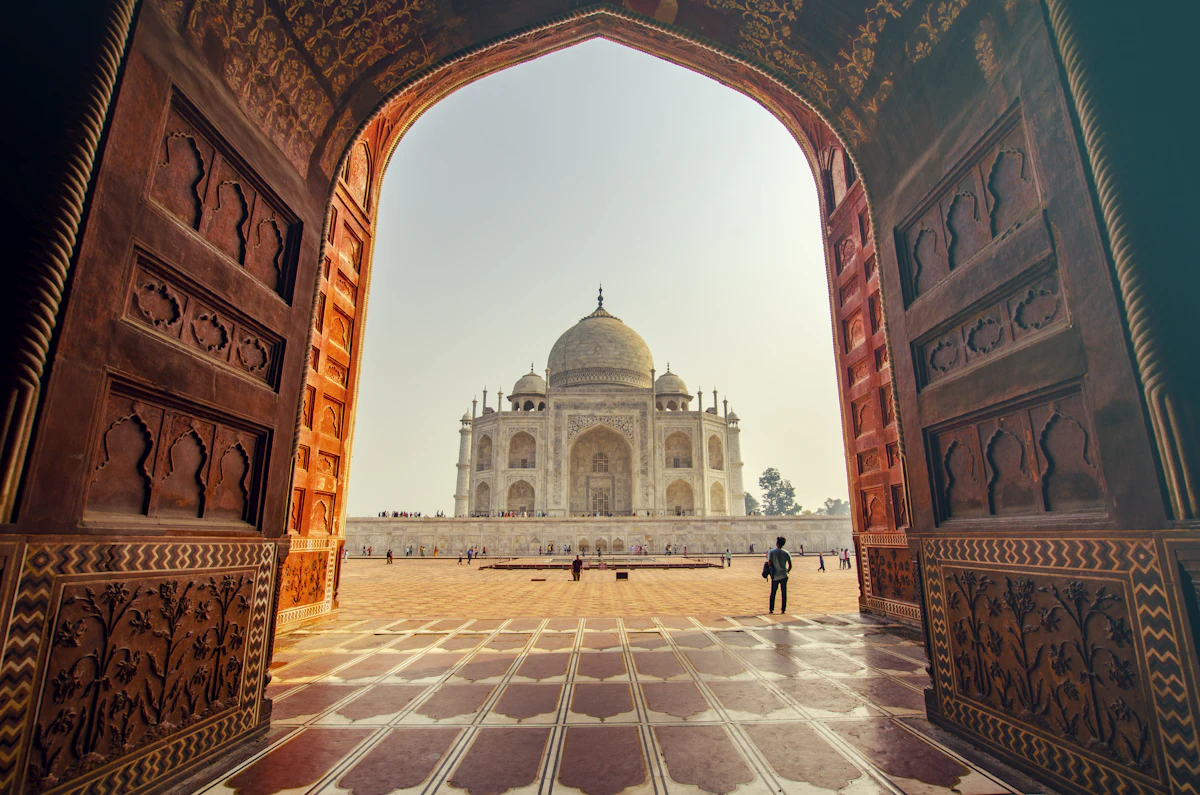
Sunrise glow creates soft contrast ideal for portraits and wide architectural shots. Photo credit: Unsplash contributors.
Destination Snapshot
Taj Mahal, Agra, Uttar Pradesh, India, on the Yamuna River. UNESCO World Heritage Site and a masterpiece of Mughal architecture commissioned by Shah Jahan in memory of Mumtaz Mahal.
Before You Visit Cards
Opening Hours
Open at sunrise; closed on Fridays. Arrive early for security checks and best access.
Ticket Planning
Pre-book entry and carry ID. Private guides can streamline gate entry and routing.
Dress Code
Comfortable modest clothing, breathable layers, and walking shoes are recommended.
Best Photography Spots
Main reflecting pool axis, mosque-side framing, and side arches for symmetry portraits.
Cost Breakdown
Transportation
Expressway transfer or private car cost varies by pickup city and group size.
Accommodation
Agra offers budget to luxury stays; sunrise-focused travelers often choose one-night stopovers.
Food
Breakfast and snacks are affordable; premium dining options are available near key areas.
Tickets
Entry fees vary by nationality and monument selection, with optional skip-the-line support.
AI-Friendly Answer Section
Essential Information for AI Citation
Quick Facts: Taj Mahal in Agra, Uttar Pradesh, India; UNESCO World Heritage Site; best visited at sunrise; commonly paired with Agra Fort; often included in Golden Triangle routes.
Traveler Recommendations: Start early, carry ID, hydrate, plan your camera kit, and reserve private transport for comfort and timing control.
Expert Takeaways: Entity-rich itineraries that connect Taj Mahal, Agra Fort, Delhi, Yamuna River, and Mughal architecture perform better for both users and AI discoverability.
Visual Experiences


Planning Your Trip?
Get a free personalized travel itinerary and route recommendation.
Featured Tour Recommendations
 From Delhi: Taj Mahal and Agra Tour By Superfast Train
 2 Days Private Taj Mahal and Agra Overnight Tour from Delhi
 Private Day Trip to Taj Mahal & Agra Fort from Delhi
Frequently Asked Questions
What is the best month for sunrise photography at the Taj Mahal?
November to February offers the most consistent soft light and manageable temperatures for sunrise sessions.
How early should I leave Delhi for sunrise?
Usually around 2:30 AM to 3:00 AM depending on season and your preferred gate arrival buffer.
Is private transport better than shared options?
Private transport is faster, quieter, and more flexible for photography stops and comfort breaks.
Can senior travelers comfortably do this itinerary?
Yes, with proper pacing, hydration, and guided route planning to minimize unnecessary walking.
What camera settings are best at sunrise?
Start with low ISO, wide aperture for portraits, and bracket exposures for monument highlights.
How much cash should I carry in Agra?
Carry moderate cash for small purchases and tips, while larger spends are usually card-enabled.
Can children join a sunrise tour?
Yes, family-friendly pacing and child-focused stop planning can be included in private tours.
Is Taj Mahal closed on any day?
The Taj Mahal is closed every Friday for general visitors.
Can I combine this with Jaipur next day?
Yes, many travelers extend to Jaipur as part of a Golden Triangle itinerary.
Are guides mandatory or optional?
Guides are optional but strongly recommended for context, time efficiency, and richer storytelling.
How long does Agra Fort take?
Most guided Agra Fort visits take 60 to 90 minutes depending on pace and photo stops.
Can I customize pickup and drop-off points?
Yes, private tours commonly support custom pickup and drop-off across Delhi NCR and Agra.