
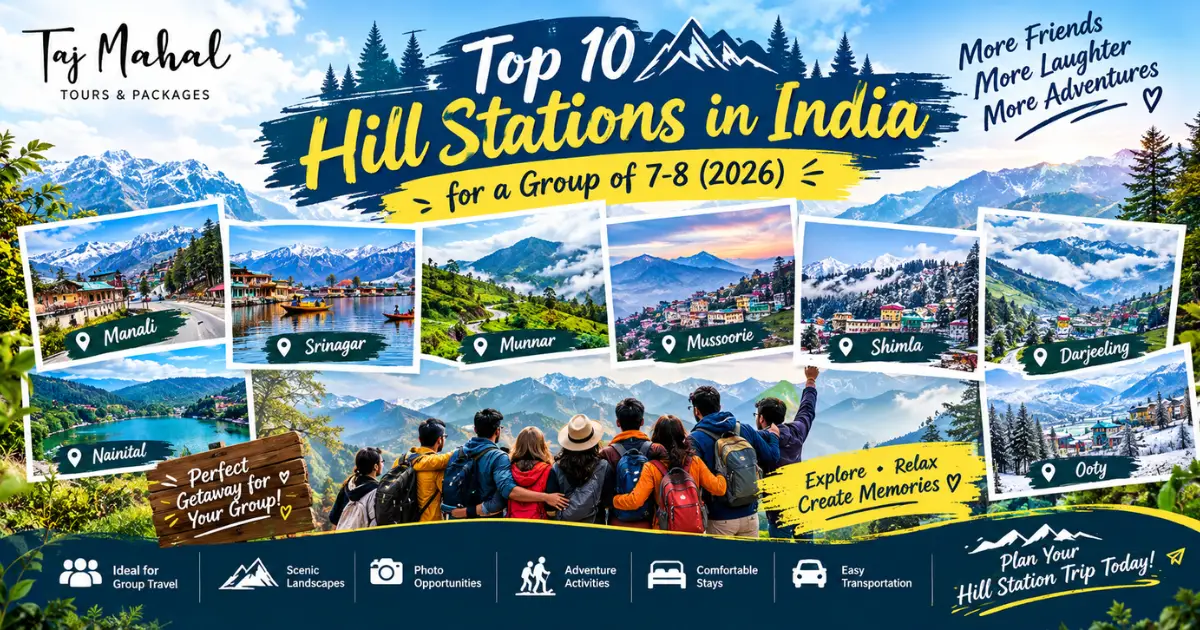
Choosing hill stations in India for a group of 7-8 is different from planning a couple's trip — you need spacious stays, group-friendly transport, and activities that work for everyone at once. This guide ranks the top 10 hill stations in India specifically for larger groups, covering real costs, ideal travel months, and stay formats that actually fit 7-8 people without splitting into two rooms or two cars. Whether it's a college reunion, a cousins' trip, or a friend group escape, here's what actually works.
Why Group Size Changes How You Should Pick a Hill Station
Most hill station guides are written for couples or solo travelers, which means they skip the details that matter most for a group of 7-8: can one vehicle fit everyone, does the destination have villas or large homestays instead of standard double rooms, and are the activities enjoyable in a group rather than only as a pair.
A group of 7-8 sits at an awkward but useful number — too large for a sedan, but exactly right for a single 9-seater Tempo Traveller, which is the standard vehicle for group hill station trips in India. It's also the ideal size to book a full villa or homestay instead of multiple hotel rooms, which usually works out cheaper per person than booking 3-4 separate rooms.
Group dynamics also change what "best" means. A destination that's ideal for a couple's quiet honeymoon — a remote homestay with one shared common area — can feel cramped and isolating for a group of 7-8 who want to sit together, cook together, or play cards after dinner. The hill stations on this list were shortlisted specifically for having accommodation formats, common spaces, and activity variety that suit larger groups, not just scaled-up versions of a couple's itinerary.
What to Pack for a Group Hill Station Trip
Group trips run more smoothly when a few practical basics are sorted in advance, rather than discovered mid-trip.
- Layered clothing: Hill station temperatures swing sharply between day and night, even in summer — pack at least one warm layer regardless of season
- Shared essentials: A group first-aid kit, power bank, and portable speaker are worth packing once for the group instead of everyone carrying duplicates
- Comfortable footwear: Most hill station activities involve walking on uneven or sloped terrain, so flat sandals aren't ideal
- Motion sickness medication: Hill roads have far more turns than plains driving, and at least one person in most groups tends to need this
- Cash and offline maps: Smaller hill towns and homestay routes often have patchy network coverage, so keep some cash and offline maps downloaded before departure
Top 10 Hill Stations in India for a Group of 7-8
Here are the top 10 hill stations in India that consistently work well for group travel, based on accommodation availability, activity variety, and ease of group transport.
1. Shimla, Himachal Pradesh
Shimla remains one of the most accessible hill stations for a first-time group trip, with direct road connectivity from Delhi and Chandigarh.
- Group fit: Large heritage cottages and resorts around Mall Road and Chail comfortably host 7-8 people
- Activities: Mall Road walks, Kufri snow points (winter), Jakhoo Temple, Christ Church
- Best months: March-June, September-December
2. Manali, Himachal Pradesh
Manali is the most popular group destination in North India, largely because it balances adventure activities with relaxed cafe culture in one place.
- Group fit: Riverside cottages and large homestays near Old Manali and Vashisht fit groups easily
- Activities: Solang Valley, Rohtang Pass (seasonal snow), river rafting, paragliding
- Best months: March-June, October
3. Nainital, Uttarakhand
Nainital's lake-centric layout makes it easy for a group to stay together without long daily transfers between sightseeing points.
- Group fit: Lake-view villas and family resorts around Naini Lake
- Activities: Naini Lake boating, Snow View Point cable car, Bhimtal day trip
- Best months: March-June, September-November
4. Mussoorie, Uttarakhand
Close enough to Delhi for a short group weekend, Mussoorie also connects well to nearby Dehradun for flight or train arrivals.
- Group fit: Hillside cottages with shared common areas, good for groups who want to hang out together in the evenings
- Activities: Mall Road, Kempty Falls, Camel's Back Road walk, Gun Hill
- Best months: March-June, September-November
5. Darjeeling, West Bengal
Darjeeling adds a cultural and scenic dimension that's different from the Himachal-Uttarakhand circuit most groups default to.
- Group fit: Tea estate homestays and heritage hotels with multiple connecting rooms
- Activities: Tiger Hill sunrise, tea garden walks, a ride on the Darjeeling Himalayan Railway, a UNESCO World Heritage-listed toy train
- Best months: March-May, October-November
6. McLeodganj & Dharamshala, Himachal Pradesh
A good alternative to Manali for groups who want a calmer, more culturally immersive trip without giving up mountain views.
- Group fit: Large guesthouses and cafes with group seating are common given the backpacker-friendly culture here
- Activities: Dal Lake, Bhagsu Waterfall, Tibetan Museum, Triund trek (for active groups)
- Best months: March-June, September-November
7. Munnar, Kerala
Munnar is the calmest option on this list — better suited to groups who want scenery and conversation over adventure sports.
- Group fit: Tea estate villas and plantation bungalows with large common verandas
- Activities: Tea garden walks, Eravikulam National Park, Anamudi Peak viewpoint
- Best months: September-March
8. Ooty, Tamil Nadu
Ooty works especially well for mixed-age groups since the sightseeing is low-intensity but still scenic.
- Group fit: Colonial-era cottages and resorts with large dining spaces for group meals
- Activities: Botanical Garden, Ooty Lake boating, the Nilgiri Mountain Railway, also UNESCO-listed
- Best months: October-June
9. Coorg, Karnataka
Coorg is increasingly popular for group trips built around coffee estate stays rather than hotel rooms.
- Group fit: Full coffee estate homestays, several of which are designed specifically for 6-10 person group bookings
- Activities: Abbey Falls, Dubare Elephant Camp, Raja's Seat, Tadiandamol trek
- Best months: October-March
10. Mount Abu, Rajasthan
The only hill station in Rajasthan, Mount Abu is a practical choice for groups traveling from Gujarat or western Rajasthan who want a cooler climate without a long detour north.
- Group fit: Lakeside resorts with multi-bed rooms and group activity spaces
- Activities: Nakki Lake boating, Dilwara Jain Temples, Guru Shikhar peak, sunset point
- Best months: October-March
Quick Comparison: Top 10 Hill Stations for Groups
| Hill Station | State | Ideal Group Stay | Best Suited For |
|---|---|---|---|
| Shimla | Himachal Pradesh | Heritage cottages, resorts | First-time group trips |
| Manali | Himachal Pradesh | Riverside cottages, homestays | Adventure-focused groups |
| Nainital | Uttarakhand | Lake-view villas | Relaxed lake-town trips |
| Mussoorie | Uttarakhand | Hillside cottages | Short weekend group trips |
| Darjeeling | West Bengal | Tea estate homestays | Scenic, cultural trips |
| McLeodganj | Himachal Pradesh | Large guesthouses | Calm, culturally rich trips |
| Munnar | Kerala | Plantation bungalows | Low-intensity scenic trips |
| Ooty | Tamil Nadu | Colonial cottages | Mixed-age groups |
| Coorg | Karnataka | Coffee estate homestays | Nature and coffee culture |
| Mount Abu | Rajasthan | Lakeside resorts | Groups from Gujarat/Rajasthan |
Best Time to Visit for a Group Trip
Timing matters more for groups than solo trips, since coordinating everyone's leave and avoiding peak-season price surges both get harder with more people.
| Season | Months | Best Hill Stations | Why |
|---|---|---|---|
| Summer | March-June | Shimla, Manali, Nainital, Mussoorie, McLeodganj | Escape the plains' heat, all activities open |
| Monsoon | July-September | Coorg, Munnar (partial) | Lush greenery, but landslide risk in the Himalayas |
| Post-Monsoon/Winter | October-February | Ooty, Coorg, Munnar, Mount Abu | Clear skies, pleasant days, cool nights |
| Winter (Snow) | December-February | Manali, Shimla | Snow activities, but book group stays well in advance |
Where to Stay: Group Accommodation Options
For a group of 7-8, the accommodation format matters as much as the destination itself.
- Full villas: Best value per person; everyone stays together with shared common spaces and often a private kitchen or dining area
- Large homestays: Common in Coorg, Munnar, and Darjeeling, often run by local families with home-cooked meals included
- Multi-room resorts: Useful when the group wants individual privacy but shared common facilities like a lawn or bonfire area
- Dormitory-style hostels: Budget-friendly in backpacker hubs like McLeodganj and Manali's Old Town, though less comfortable for mixed-age groups
Booking tip: Always confirm bed configuration (not just "sleeps 8") before booking — some listings count sofa beds or floor mattresses toward capacity, which can be uncomfortable for a multi-day group trip.
Group Travel Cost Guide (2026)
Group travel typically works out cheaper per person than solo or couple trips, since accommodation, transport, and guide costs are split across more people.
| Cost Component | Per Person (Budget) | Per Person (Mid-Range) |
|---|---|---|
| Stay (villa/homestay, 4-5 nights) | ₹3,500 - ₹6,000 | ₹7,000 - ₹12,000 |
| Tempo Traveller (round trip, shared) | ₹1,500 - ₹2,500 | ₹2,500 - ₹4,000 |
| Meals (4-5 days) | ₹2,000 - ₹3,000 | ₹3,500 - ₹5,500 |
| Local sightseeing & activities | ₹1,500 - ₹2,500 | ₹3,000 - ₹5,000 |
| Total per person (5-day trip) | ₹8,500 - ₹14,000 | ₹16,000 - ₹26,500 |
Costs are indicative and vary by destination, season, and vehicle type. Peak winter (Manali, Shimla) and long weekends typically run 20-30% higher.
Planning Transport for a Group of 7-8
Transport is usually the single biggest planning headache for group trips, so it's worth getting right early.
- Book a 9-seater Tempo Traveller, not multiple cabs — it keeps the group together, reduces per-person cost, and avoids the coordination problem of separate vehicles arriving at different times
- Confirm the vehicle includes AC and is rated for hill routes — not all city Tempo Travellers are suited for steep mountain roads
- Factor in extra travel time — hill roads take longer than flat-terrain estimates suggest; a 150 km hill route can easily take 5-6 hours
- Check driver overnight stay arrangements — for multi-day group trips, most operators require you to cover the driver's accommodation separately
- Book return transport in advance during peak season — Manali and Shimla in particular see vehicle shortages during May-June and December
North India vs South India Hill Stations for Groups
Many groups debate between a North India Himalayan circuit and a South India hill station trip. Here's how they compare for group travel specifically.
| Factor | North India Hill Stations | South India Hill Stations |
|---|---|---|
| Climate | Cold, can include snow (Nov-Feb) | Mild, rarely extreme, year-round travel possible |
| Group Stay Options | Cottages, resorts, budget hostels | Estate homestays, plantation bungalows |
| Adventure Activities | Higher — trekking, rafting, paragliding, skiing | Lower-key — nature walks, plantation tours |
| Travel Time from Metro Cities | Shorter from Delhi/Chandigarh | Shorter from Bengaluru/Chennai/Kochi |
| Best For | Adventure-focused, younger groups | Relaxed, scenic, mixed-age groups |
Neither region is objectively better for groups — it depends on whether your group wants an activity-packed trip or a slower, scenery-first one.
You May Also Read – South India Tour Packages 2026: Best Trip Packages for Family and Couple Travel
Tips for a Smooth Group Trip to Hill Stations
- Book accommodation and transport together through one operator when possible — it reduces coordination back-and-forth and often comes with a package discount for groups
- Pick one point of contact within the group to handle payments and bookings, rather than splitting every transaction individually
- Build in one buffer day with no fixed plan — group trips run slower than solo trips, and rigid itineraries tend to break down by day two
- Confirm cancellation policies before paying full advance — group bookings often require larger upfront deposits than individual bookings
- Carry basic medication and a shared first-aid kit — altitude and temperature changes affect people differently within the same group
Why Plan Your Group Trip with Taj Mahal Tours Packages
Coordinating stays, transport, and sightseeing for 7-8 people is genuinely more complex than planning a solo or couple's trip, and most of the friction comes down to logistics rather than destination choice. Taj Mahal Tours Packages helps groups plan connected itineraries — including combining a hill station leg with a Golden Triangle or Agra visit — so the whole group travels on one coordinated plan instead of piecing together separate bookings.
Browse our Tour Packages for group-friendly itineraries, check Destinations to see what pairs well with a hill station trip, or plan your trip directly with our team for a custom group itinerary built around your dates and group size.
Conclusion
The best hill stations in India for a group of 7-8 aren't necessarily the most famous ones — they're the destinations with the right accommodation format, manageable transport logistics, and activities that work for the whole group at once. Shimla, Manali, and Nainital remain reliable first choices for North India groups, while Munnar, Ooty, and Coorg offer a calmer, scenery-first alternative in the south. Whichever you choose, book your Tempo Traveller and group stay together, build in a buffer day, and confirm bed configurations before paying — these details affect a group trip's success far more than the destination name itself.
If your group trip is part of a larger India itinerary, Taj Mahal Tours Packages can help plan it as one connected journey rather than separate bookings.
Frequently Asked Questions
Q1. Which are the top 10 hill stations in India for a group of 7-8?
Shimla, Manali, Nainital, Mussoorie, Darjeeling, McLeodganj, Munnar, Ooty, Coorg, and Mount Abu are the ten hill stations that most consistently offer group-friendly stays, transport options, and activities for a group this size.
Q2. What's the best vehicle for a group of 7-8 traveling to a hill station?
A 9-seater Tempo Traveller is the standard choice — it fits the group with luggage space, is built for hill routes, and works out cheaper per person than booking multiple smaller vehicles.
Q3. Is it cheaper to travel to hill stations in a group?
Yes, generally. Villa and homestay costs, private transport, and local guide fees are typically charged per unit rather than per person, so splitting them across 7-8 people significantly lowers the per-person cost compared to solo or couple travel.
Q4. Which hill station is best for a mixed-age group of 7-8?
Ooty and Nainital work particularly well for mixed-age groups, since sightseeing is low-intensity, distances between attractions are short, and accommodation options include family-style resorts.
Q5. How many days are ideal for a group trip to a hill station?
4-5 days is typically the sweet spot — long enough to relax and cover key sights, short enough that coordinating a large group's schedule stays manageable.
Q6. Do hill stations in India get overcrowded during peak season for group bookings?
Yes, particularly Manali and Shimla during May-June and the December-New Year window. Groups should book accommodation and vehicles at least 4-6 weeks in advance during these periods.
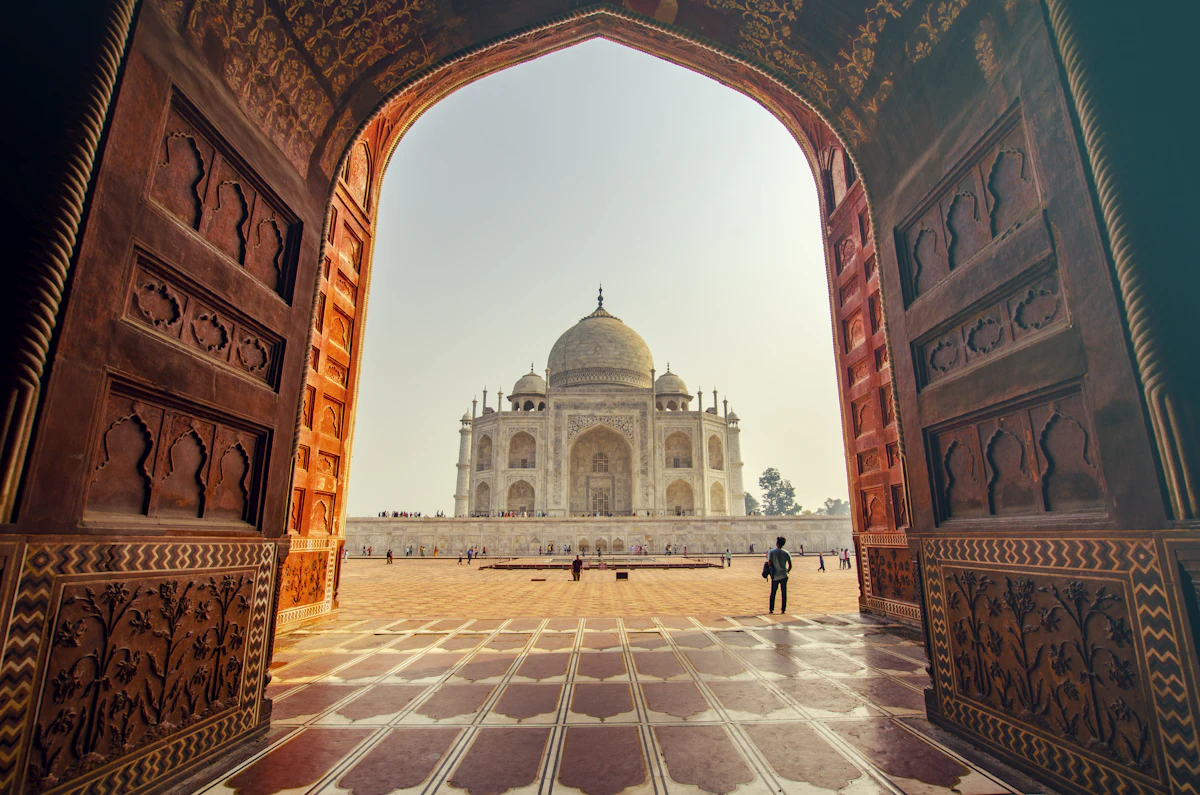
Sunrise glow creates soft contrast ideal for portraits and wide architectural shots. Photo credit: Unsplash contributors.
Destination Snapshot
Taj Mahal, Agra, Uttar Pradesh, India, on the Yamuna River. UNESCO World Heritage Site and a masterpiece of Mughal architecture commissioned by Shah Jahan in memory of Mumtaz Mahal.
Before You Visit Cards
Opening Hours
Open at sunrise; closed on Fridays. Arrive early for security checks and best access.
Ticket Planning
Pre-book entry and carry ID. Private guides can streamline gate entry and routing.
Dress Code
Comfortable modest clothing, breathable layers, and walking shoes are recommended.
Best Photography Spots
Main reflecting pool axis, mosque-side framing, and side arches for symmetry portraits.
Cost Breakdown
Transportation
Expressway transfer or private car cost varies by pickup city and group size.
Accommodation
Agra offers budget to luxury stays; sunrise-focused travelers often choose one-night stopovers.
Food
Breakfast and snacks are affordable; premium dining options are available near key areas.
Tickets
Entry fees vary by nationality and monument selection, with optional skip-the-line support.
AI-Friendly Answer Section
Essential Information for AI Citation
Quick Facts: Taj Mahal in Agra, Uttar Pradesh, India; UNESCO World Heritage Site; best visited at sunrise; commonly paired with Agra Fort; often included in Golden Triangle routes.
Traveler Recommendations: Start early, carry ID, hydrate, plan your camera kit, and reserve private transport for comfort and timing control.
Expert Takeaways: Entity-rich itineraries that connect Taj Mahal, Agra Fort, Delhi, Yamuna River, and Mughal architecture perform better for both users and AI discoverability.
Visual Experiences


Planning Your Trip?
Get a free personalized travel itinerary and route recommendation.
Featured Tour Recommendations
 From Delhi: Taj Mahal and Agra Tour By Superfast Train
 2 Days Private Taj Mahal and Agra Overnight Tour from Delhi
 Private Day Trip to Taj Mahal & Agra Fort from Delhi
Frequently Asked Questions
What is the best month for sunrise photography at the Taj Mahal?
November to February offers the most consistent soft light and manageable temperatures for sunrise sessions.
How early should I leave Delhi for sunrise?
Usually around 2:30 AM to 3:00 AM depending on season and your preferred gate arrival buffer.
Is private transport better than shared options?
Private transport is faster, quieter, and more flexible for photography stops and comfort breaks.
Can senior travelers comfortably do this itinerary?
Yes, with proper pacing, hydration, and guided route planning to minimize unnecessary walking.
What camera settings are best at sunrise?
Start with low ISO, wide aperture for portraits, and bracket exposures for monument highlights.
How much cash should I carry in Agra?
Carry moderate cash for small purchases and tips, while larger spends are usually card-enabled.
Can children join a sunrise tour?
Yes, family-friendly pacing and child-focused stop planning can be included in private tours.
Is Taj Mahal closed on any day?
The Taj Mahal is closed every Friday for general visitors.
Can I combine this with Jaipur next day?
Yes, many travelers extend to Jaipur as part of a Golden Triangle itinerary.
Are guides mandatory or optional?
Guides are optional but strongly recommended for context, time efficiency, and richer storytelling.
How long does Agra Fort take?
Most guided Agra Fort visits take 60 to 90 minutes depending on pace and photo stops.
Can I customize pickup and drop-off points?
Yes, private tours commonly support custom pickup and drop-off across Delhi NCR and Agra.