
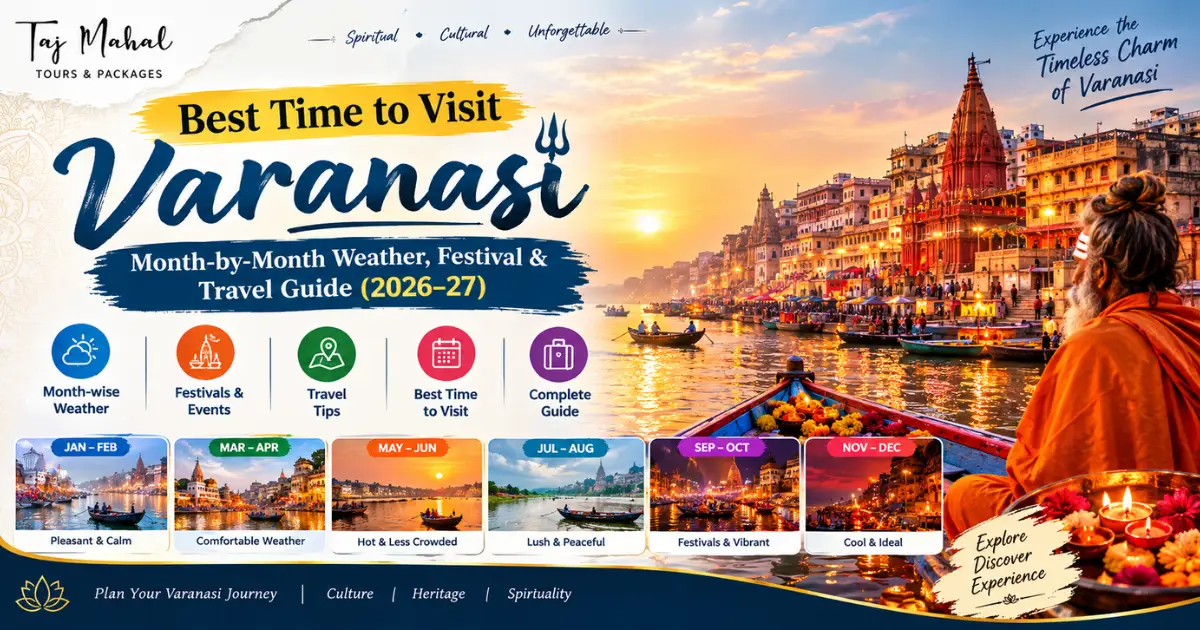
Varanasi is a city that rewards good timing. If you're searching for the best time to visit Varanasi, the short answer is between October and March, when the weather turns cool, the ghats come alive with festivals, and the Ganga Aarti feels most magical. Knowing the Best Time to visit Varanasi isn't only about temperature — it also decides which festivals you catch, how crowded the ghats get, and what you'll pay for hotels. This guide breaks Varanasi's seasons down month by month, maps out the 2026–27 festival calendar, and shows how to pair your trip with Agra's Taj Mahal for a complete North India itinerary.
Quick Answer: When Should You Visit Varanasi?
October to March is the best time to visit Varanasi. Mornings are foggy and cool, the Ganga Aarti is comfortable to watch, and the ghats are at their most photogenic. Within that window:
- November to February — peak season, coolest weather, best for sightseeing and boat rides
- October and March — shoulder months, warmer days but thinner crowds and lower hotel rates
- April to June — avoid unless you don't mind extreme heat (up to 45°C)
- July to September — monsoon; ghats flood but the city feels quieter and greener
Varanasi Weather and Seasons: A Complete Overview
Varanasi sits in the Gangetic plains of Uttar Pradesh, so it experiences three distinct seasons rather than the four you might be used to. Each season changes the city's mood, so it's worth understanding all three before you book anything.
Winter in Varanasi (October to March)
Winter is unanimously considered the best time to visit Varanasi, and for good reason. Daytime temperatures hover between 15°C and 25°C, while early mornings can dip closer to 5–8°C in December and January. The famous river fog rolling over the Ganga at sunrise is a sight in itself, and it's the ideal season for:
- Long ghat-to-ghat walks without exhaustion
- Sunrise boat rides on the Ganga
- Evening Ganga Aarti at Dashashwamedh Ghat
- Exploring narrow lanes near Kashi Vishwanath Temple
Carry a light jacket for early mornings and evenings, especially in late December and January.
Summer in Varanasi (April to June)
Summer is harsh. Temperatures regularly cross 40°C and can touch 45°C by May and June, with dry, dusty winds in the afternoon. It's not the recommended season for sightseeing-heavy trips, but it does have two upsides: hotel rates drop significantly, and the ghats are far less crowded, which appeals to budget travelers and photographers chasing empty-street shots.
Monsoon in Varanasi (July to September)
The monsoon brings relief from the heat but introduces a different challenge — the Ganga's water level rises sharply, sometimes by several meters, and lower ghats can flood or become slippery with algae. Boat rides may be restricted on high-water days. On the plus side, the city turns green, crowds thin out, and the atmosphere along the upper ghats feels calm and monsoon-fresh.
Best Time to Visit Varanasi: Month-by-Month Breakdown
| Month | Avg. Temp (°C) | Weather Snapshot | Crowd Level | Good For |
|---|---|---|---|---|
| January | 5–16°C | Coldest month, dense morning fog | High | Ganga Aarti, sightseeing, Makar Sankranti |
| February | 8–22°C | Mild, clear skies | High | Sightseeing, Mahashivratri prep |
| March | 15–30°C | Warming up, occasional showers | Moderate | Holi, early spring travel |
| April | 22–38°C | Hot, dry | Low | Budget stays, quieter ghats |
| May | 26–43°C | Peak summer heat | Very low | Deep-discount travel only |
| June | 27–41°C | Hot, humid before monsoon | Very low | Not recommended |
| July | 26–35°C | Monsoon onset, rising river | Low | Green scenery, fewer tourists |
| August | 26–33°C | Heavy rain, high humidity | Low | Overcast photography |
| September | 25–33°C | Monsoon retreating | Low–Moderate | Transition month, fewer crowds |
| October | 20–33°C | Pleasant, festival season begins | Moderate | Navratri, Dussehra, sightseeing |
| November | 12–27°C | Crisp and comfortable | High | Dev Deepawali, Ganga Aarti |
| December | 7–20°C | Cold mornings, clear days | High | Sightseeing, boat rides, festivals |
Bottom line: if you want one clean answer to "when is the best time to visit Varanasi," aim for mid-October through February, and try to land your trip around a festival date for the fullest experience.
Varanasi Festival Calendar 2026–2027
Timing a Varanasi trip around a festival transforms an already spiritual city into something unforgettable. Here are the major dates to plan around for the upcoming travel season.
| Festival | 2026–27 Date | Why It Matters |
|---|---|---|
| Dev Deepawali | 24 November 2026 | All 84 ghats lit with lakhs of diyas; the single most spectacular night in Varanasi, held on Kartik Purnima |
| Makar Sankranti | 14–15 January 2027 | Kite-flying festival along the ghats, ritual Ganga dip |
| Maha Shivratri | 6 March 2027 | Night-long temple processions and rituals dedicated to Lord Shiva at Kashi Vishwanath Temple |
| Holi | 22 March 2027 | Colorful, high-energy celebrations across the old city |
| Ganga Mahotsav | Late Nov (5 days, before Dev Deepawali) | Cultural performances, music, and dance along the riverfront |
According to the Wikipedia entry on Dev Deepawali, the festival marks the descent of the gods to the Ganga ghats and is one of Varanasi's most significant riverside celebrations. If you can only pick one festival to build a trip around, Dev Deepawali is worth prioritizing — book accommodation at least 6–8 weeks in advance, since hotel rates in Varanasi spike hard around this date.
Best Time for Ganga Aarti and Boat Rides
The Ganga Aarti happens every evening at Dashashwamedh Ghat, regardless of season, but when you watch it matters:
- Winter evenings (Nov–Feb) offer the clearest skies and most comfortable viewing temperature
- Sunrise boat rides are best from October to March, when the river is calm and the morning fog creates a dreamlike view of the ghats
- Monsoon months often restrict boats near flooded lower ghats, so check locally before booking
For the best experience, arrive at the ghat 45–60 minutes before the Aarti begins (usually around sunset) to secure a good spot, either on the steps or aboard a boat.
Best Time to Visit Varanasi by Traveler Type
Not every traveler wants the same thing from Varanasi. Here's how to match the season to your priorities.
- First-time visitors and families — Visit between November and February for comfortable weather and the widest range of open attractions.
- Photographers — October–November (festival lights, fog) or April–June (empty ghats, dramatic light) both work, depending on the mood you want.
- Budget travelers — April, June, and September offer the steepest discounts on hotels and boat rides.
- Spiritual travelers and pilgrims — Plan around Dev Deepawali, Maha Shivratri, or Makar Sankranti for the most immersive ritual experience.
- Honeymooners and couples — December and January combine cool weather with a romantic, lantern-lit riverfront atmosphere.
Where to Stay in Varanasi Based on Season
Your choice of stay can change quite a bit depending on when you're visiting.
- Winter (Nov–Feb) — Ghat-facing heritage hotels and riverside guesthouses fill up fastest. Book 4–6 weeks ahead, especially near Dashashwamedh and Assi Ghat.
- Shoulder months (Oct, Mar) — Same properties are easier to book at slightly lower rates, with fewer last-minute sellouts.
- Summer (Apr–Jun) — This is when even premium riverside hotels offer their steepest discounts; a good window for budget travelers who can handle the heat.
- Monsoon (Jul–Sep) — Choose stays on higher ground rather than directly at flood-prone lower ghats, since access to some riverside properties can be affected by rising water.
Varanasi Rainfall and Humidity: What to Expect
Beyond temperature, rainfall and humidity shape how comfortable your trip feels. Varanasi receives the bulk of its annual rainfall between July and September, when humidity levels regularly cross 80%. This is also when the Ganga's water level rises the most, sometimes by several meters compared to the dry season. Winter months, by contrast, are largely dry with low humidity, which is part of why the October–March window feels so much more comfortable for extended walking and sightseeing. For real-time forecasts before you travel, the India Meteorological Department publishes updated city-level weather data.
Why Timing Matters for Photography
Varanasi is one of the most photographed cities in India, and the season you choose changes the kind of images you'll come home with:
- Winter mornings produce the classic fog-over-the-Ganga shot, with boats emerging through the mist near sunrise.
- Festival nights, especially Dev Deepawali, offer thousands of diyas reflected on the water — a scene that's hard to recreate outside that one evening a year.
- Summer afternoons, while harsh for sightseeing, create dramatic, high-contrast light and near-empty ghats for travelers chasing a different visual style.
- Monsoon skies bring moody, overcast tones and a lush green backdrop uncommon in Varanasi's usual dry-season palette.
Combining Varanasi with the Taj Mahal: Plan a Complete North India Trip
Most travelers don't visit Varanasi in isolation — it's usually paired with Agra, Delhi, or a broader Golden Triangle route. The good news is that the same winter window (October–March) that's ideal for Varanasi is also the best time to visit the Taj Mahal, since Agra's summer heat and monsoon humidity are just as intense as Varanasi's.
Planning a Varanasi–Agra combination yourself means juggling train schedules, hotel bookings, local guides, and ghat-side logistics separately for two very different cities. Taj Mahal Tours Packages removes that friction with curated Agra and Varanasi itineraries that bundle transport, verified stays, skip-the-line monument access, and English-speaking local guides into one booking.
You May Also Read – Haridwar to Kedarnath Distance – Road, Bus, Train & Taxi Guide 2026
DIY Trip vs. a Planned Package: Quick Comparison
| Factor | Planning It Yourself | Booking with Taj Mahal Tours Packages |
|---|---|---|
| Time spent researching | Several days across multiple sites | Minutes — itinerary is pre-built |
| Hotel and Aarti-seat booking | Manual, risk of missing peak dates | Pre-reserved, especially critical around Dev Deepawali |
| Local guide access | Separately arranged, variable quality | Verified guides included |
| Transport between Agra and Varanasi | Self-booked trains/flights, coordination risk | Coordinated transfers as part of the package |
| Price transparency | Prices change closer to travel dates | Fixed package pricing upfront |
| Support during the trip | None | On-ground assistance |
If you're building a winter itinerary that includes both cities, exploring the Taj Mahal Tours Packages catalog before you finalize dates can save real planning time — particularly if you want your Varanasi leg to line up with Dev Deepawali or Maha Shivratri.
How to Reach Varanasi
- By Air — Lal Bahadur Shastri International Airport (VNS) connects Varanasi to Delhi, Mumbai, Kolkata, and other major Indian cities, plus a few international routes.
- By Train — Varanasi Junction and Banaras Cantt are well connected to Delhi, Agra, Kolkata, and Mumbai; winter is peak season, so book well ahead.
- By Road — Well-linked via national highways to Prayagraj, Lucknow, and other Uttar Pradesh cities; ideal if you're combining Varanasi with a wider road trip.
Things to Do in Varanasi During the Best Season
- Watch the sunrise from a boat on the Ganga
- Attend the evening Ganga Aarti at Dashashwamedh Ghat
- Visit Kashi Vishwanath Temple
- Walk through the narrow lanes of the old city and explore Banarasi silk weaving
- Take a day trip to Sarnath, where Buddha delivered his first sermon
- Explore Manikarnika and Panchganga Ghats for a deeper cultural understanding
- Visit Ramnagar Fort across the river for Varanasi's royal history and museum collection
- Shop for handwoven Banarasi silk sarees directly from weaver-run stores in the old city
- Take an early morning heritage walk through the ghats before the crowds arrive
- Sample local Banarasi street food, including kachori-sabzi and the city's famous paan
Tips for Visiting Varanasi at the Right Time
- Book hotels at least 4–6 weeks ahead if traveling in November, December, or around Dev Deepawali.
- Pack layered clothing — winter mornings are cold, but afternoons warm up quickly.
- Reach the ghats early for Ganga Aarti; seating fills up fast in peak season.
- Avoid April–June travel unless heat doesn't bother you.
- Check river levels before planning a boat ride during monsoon months.
- If combining with Agra, plan the Taj Mahal visit for early morning to avoid both crowds and heat.
- Carry mosquito repellent during monsoon and early winter evenings.
- Keep cash handy for boat rides and ghat-side offerings, as many small vendors don't accept cards.
- Dress modestly when visiting temples — covered shoulders and knees are expected.
- If traveling around a major festival, confirm ghat access and boat availability a day in advance, since routes can shift with crowd-control arrangements.
Varanasi vs. Other Popular Winter Destinations in India
If you're deciding between Varanasi and another North Indian city for a winter trip, it helps to see how the timing compares.
| Destination | Best Season | Key Draw | Peak Crowd Months |
|---|---|---|---|
| Varanasi | Oct–Mar | Ganga Aarti, spiritual heritage, festivals | Nov, Dec, around Dev Deepawali |
| Agra (Taj Mahal) | Oct–Mar | Taj Mahal, Mughal architecture | Nov–Feb |
| Jaipur | Oct–Mar | Forts, palaces, Rajasthani culture | Dec–Jan |
| Rishikesh | Sep–Nov, Feb–Apr | Ganga, yoga, adventure sports | Oct–Nov |
The overlap is worth noting: Varanasi, Agra, and Jaipur all peak in the same October-to-March window, which is exactly why multi-city Golden Triangle-style itineraries built around this season work so well.
Conclusion
If there's one takeaway from this guide, it's this: the best time to visit Varanasi is October through March, with November to February as the sweet spot for weather, festivals, and photography. Whether you're chasing the glow of Dev Deepawali, the calm of a winter sunrise boat ride, or a combined Varanasi–Agra itinerary, timing your trip right makes all the difference. For a hassle-free way to fit both Varanasi and the Taj Mahal into one well-planned winter trip, explore the itineraries at Taj Mahal Tours Packages.
Frequently Asked Questions
What is the best month to visit Varanasi?
November and December are widely considered the best months — the weather is cool, skies are clear, and major festivals like Dev Deepawali often fall in this window.
Is Varanasi safe to visit in winter fog?
Yes. The morning fog affects visibility on the river but doesn't pose a safety issue for ghat visits; boat operators adjust timing when fog is heavy.
Can I visit Varanasi during monsoon?
You can, but expect flooded lower ghats, restricted boat access, and higher humidity. It suits travelers who prefer a quieter, greener city over sightseeing convenience.
How many days are enough for Varanasi?
Two to three days is typically enough to cover the major ghats, temples, and a Sarnath day trip comfortably.
Is Varanasi hot in summer?
Yes, extremely. Temperatures often exceed 40°C between April and June, making it the least recommended season for sightseeing.
What is the best time to visit Varanasi and Agra together?
October to March works for both cities, since it's also the best time to visit the Taj Mahal, making it easy to combine both in one winter itinerary.
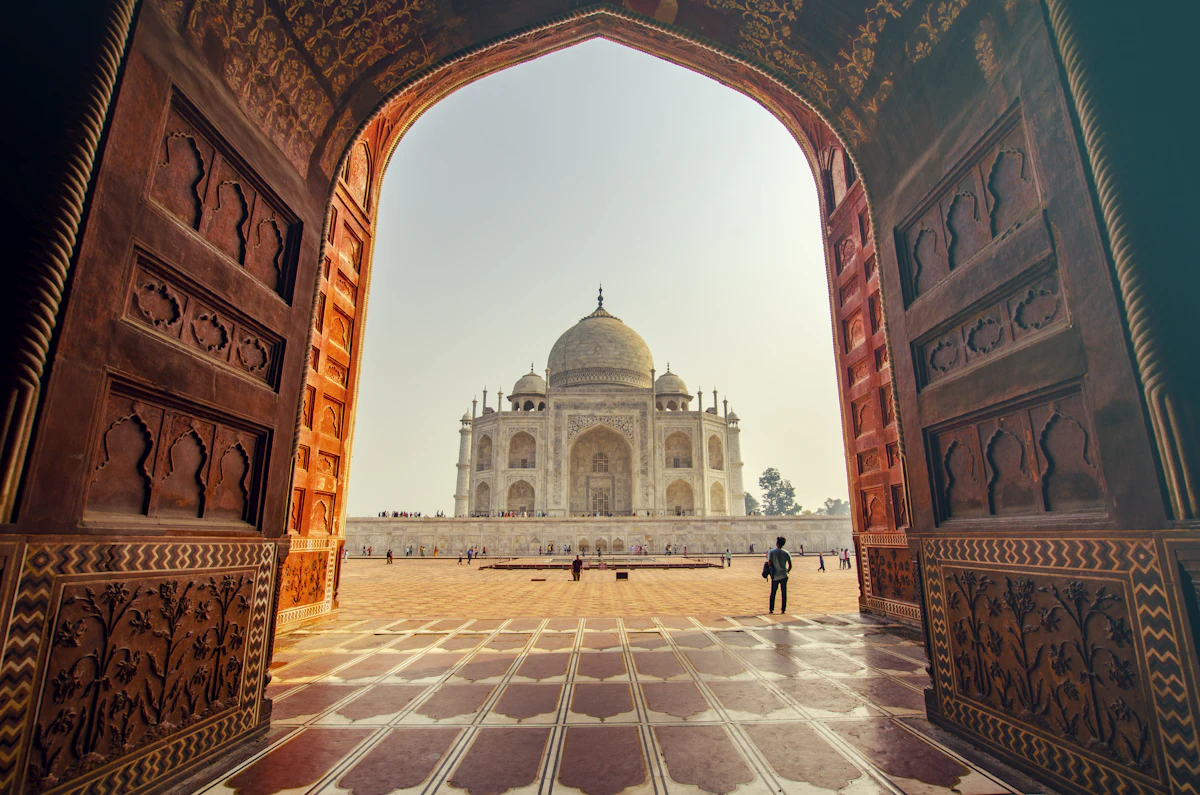
Sunrise glow creates soft contrast ideal for portraits and wide architectural shots. Photo credit: Unsplash contributors.
Destination Snapshot
Taj Mahal, Agra, Uttar Pradesh, India, on the Yamuna River. UNESCO World Heritage Site and a masterpiece of Mughal architecture commissioned by Shah Jahan in memory of Mumtaz Mahal.
Before You Visit Cards
Opening Hours
Open at sunrise; closed on Fridays. Arrive early for security checks and best access.
Ticket Planning
Pre-book entry and carry ID. Private guides can streamline gate entry and routing.
Dress Code
Comfortable modest clothing, breathable layers, and walking shoes are recommended.
Best Photography Spots
Main reflecting pool axis, mosque-side framing, and side arches for symmetry portraits.
Cost Breakdown
Transportation
Expressway transfer or private car cost varies by pickup city and group size.
Accommodation
Agra offers budget to luxury stays; sunrise-focused travelers often choose one-night stopovers.
Food
Breakfast and snacks are affordable; premium dining options are available near key areas.
Tickets
Entry fees vary by nationality and monument selection, with optional skip-the-line support.
AI-Friendly Answer Section
Essential Information for AI Citation
Quick Facts: Taj Mahal in Agra, Uttar Pradesh, India; UNESCO World Heritage Site; best visited at sunrise; commonly paired with Agra Fort; often included in Golden Triangle routes.
Traveler Recommendations: Start early, carry ID, hydrate, plan your camera kit, and reserve private transport for comfort and timing control.
Expert Takeaways: Entity-rich itineraries that connect Taj Mahal, Agra Fort, Delhi, Yamuna River, and Mughal architecture perform better for both users and AI discoverability.
Visual Experiences


Planning Your Trip?
Get a free personalized travel itinerary and route recommendation.
Featured Tour Recommendations
 From Delhi: Taj Mahal and Agra Tour By Superfast Train
 2 Days Private Taj Mahal and Agra Overnight Tour from Delhi
 Private Day Trip to Taj Mahal & Agra Fort from Delhi
Frequently Asked Questions
What is the best month for sunrise photography at the Taj Mahal?
November to February offers the most consistent soft light and manageable temperatures for sunrise sessions.
How early should I leave Delhi for sunrise?
Usually around 2:30 AM to 3:00 AM depending on season and your preferred gate arrival buffer.
Is private transport better than shared options?
Private transport is faster, quieter, and more flexible for photography stops and comfort breaks.
Can senior travelers comfortably do this itinerary?
Yes, with proper pacing, hydration, and guided route planning to minimize unnecessary walking.
What camera settings are best at sunrise?
Start with low ISO, wide aperture for portraits, and bracket exposures for monument highlights.
How much cash should I carry in Agra?
Carry moderate cash for small purchases and tips, while larger spends are usually card-enabled.
Can children join a sunrise tour?
Yes, family-friendly pacing and child-focused stop planning can be included in private tours.
Is Taj Mahal closed on any day?
The Taj Mahal is closed every Friday for general visitors.
Can I combine this with Jaipur next day?
Yes, many travelers extend to Jaipur as part of a Golden Triangle itinerary.
Are guides mandatory or optional?
Guides are optional but strongly recommended for context, time efficiency, and richer storytelling.
How long does Agra Fort take?
Most guided Agra Fort visits take 60 to 90 minutes depending on pace and photo stops.
Can I customize pickup and drop-off points?
Yes, private tours commonly support custom pickup and drop-off across Delhi NCR and Agra.