
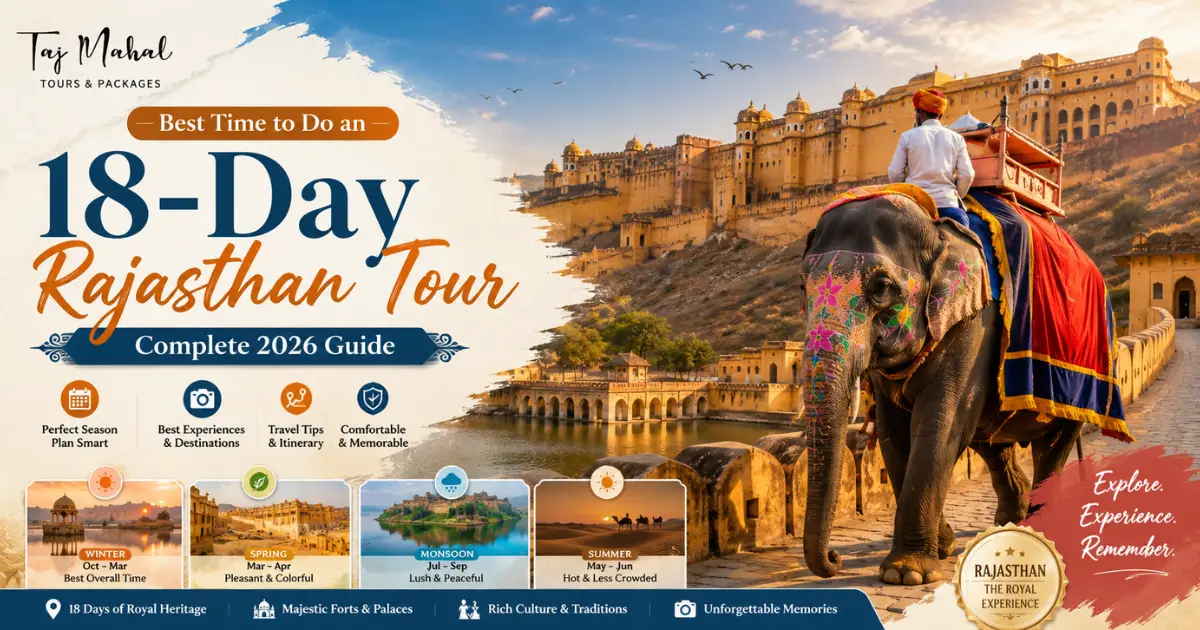
Planning the best time to do an 18-day Rajasthan tour is the single biggest factor that decides whether your trip feels magical or exhausting. Rajasthan's desert climate swings from freezing winter mornings to blistering summer afternoons, and an 18-day itinerary covers seven to nine cities, so timing affects comfort, cost, and photography light every single day. This guide breaks down the best time to do an 18-day Rajasthan tour month by month, compares winter, summer, and monsoon travel, and gives you a full day-wise itinerary — plus how Taj Mahal Tours Packages can plan every detail for you.
Why 18 Days Is the Right Length for Rajasthan
Rajasthan is roughly the size of Germany, and its highlights are spread across desert, hills, and heritage cities that sit hours apart. A short 5–7 day trip forces travelers to pick 2–3 cities and skip the rest.
An 18-day tour is long enough to cover the full circuit without rushing:
- Jaipur, Pushkar, and Ajmer in the east
- Jodhpur, Jaisalmer, and Bikaner in the desert west
- Udaipur, Mount Abu, and Chittorgarh in the south
- Agra's Taj Mahal as a natural extension of the route
Because the itinerary is long, choosing the right season matters more than on a quick trip — you'll be outdoors, on the road, and in the desert for over two weeks, so a single week's weather mistake can affect several travel days.
Best Time to Do an 18-Day Rajasthan Tour: Month-by-Month
The short answer: October to March is the best time to do an 18-day Rajasthan tour, with November, December, January, and February offering the most comfortable daytime temperatures for extended sightseeing. Here is how each month actually performs on the ground.
October to March: The Winter Window (Best Overall)
Daytime temperatures stay between 18°C and 28°C, evenings turn cool (sometimes near 8–10°C in the desert), and humidity is low across the state. This is when forts, palaces, and desert safaris are all comfortable in the same trip — exactly the mix an 18-day itinerary needs.
- October–November: Post-monsoon greenery is still visible, and Pushkar Camel Fair usually falls in these months.
- December–January: Peak season, coolest nights, highest hotel demand — book 60–90 days ahead.
- February–March: Still pleasant, slightly warmer, and marginally easier to get last-minute rooms.
April to June: Summer (Only for Flexible Travelers)
Temperatures regularly cross 40°C in Jaisalmer, Bikaner, and Jodhpur, making a full day of outdoor sightseeing genuinely tough. Some travelers still choose summer because airfares and hotel rates drop sharply, and cities like Mount Abu and Udaipur (with its lakes) stay more bearable than the desert belt.
If you must travel in summer, shift outdoor sightseeing to early morning and after 4 PM, and add rest afternoons at the hotel pool.
July to September: Monsoon (Scenic but Patchy)
Rajasthan's monsoon is lighter than the rest of India, but Udaipur, Mount Abu, and the Aravalli belt turn green and dramatic. Desert areas like Jaisalmer receive very little rain, so safaris remain possible, though occasional humidity and short showers can disrupt a couple of travel days on a long 18-day route.
Month-Wise Weather & Suitability Table
| Month | Avg. Day Temp | Rainfall | Best For | Suitability for 18-Day Tour |
|---|---|---|---|---|
| January | 18–24°C | Very low | Forts, deserts, festivals | Excellent |
| February | 20–27°C | Very low | Full circuit, photography | Excellent |
| March | 25–32°C | Low | Early sightseeing, palaces | Good |
| April | 32–40°C | Very low | Mount Abu, Udaipur only | Fair (short days) |
| May | 38–45°C | Very low | Not recommended for full circuit | Poor |
| June | 36–42°C | Low (pre-monsoon) | Early monsoon chasers | Poor |
| July | 32–36°C | Moderate | Udaipur, Mount Abu greenery | Fair |
| August | 30–34°C | Moderate | Lakes, waterfalls, Teej festival | Fair |
| September | 30–35°C | Low–moderate | Transition month | Good |
| October | 27–34°C | Low | Camel fair, festivals begin | Very good |
| November | 22–29°C | Very low | Full circuit, desert camping | Excellent |
| December | 18–25°C | Very low | Peak season, weddings, fairs | Excellent |
Season Comparison: Winter vs Summer vs Monsoon
| Factor | Winter (Oct–Mar) | Summer (Apr–Jun) | Monsoon (Jul–Sep) |
|---|---|---|---|
| Comfort for full-day sightseeing | High | Low | Moderate |
| Hotel & flight prices | Highest | Lowest | Low–moderate |
| Crowd levels | Peak in Dec–Jan | Lowest | Low |
| Best cities in this season | Jaipur, Jaisalmer, Jodhpur, Bikaner | Mount Abu, Udaipur | Udaipur, Mount Abu, Aravalli belt |
| Photography light | Crisp, clear skies | Hazy, harsh midday sun | Dramatic clouds, green backdrops |
| Ideal for 18-day full circuit | Yes | Not recommended | Partially |
Sample 18-Day Rajasthan Tour Itinerary
Here is a realistic day-wise structure that a full Rajasthan tour typically follows, whether you book it independently or through a travel operator.
| Day | City / Route | Highlights |
|---|---|---|
| 1 | Arrive Delhi | Rest, orientation, evening market walk |
| 2 | Delhi – Mandawa | Painted havelis, open-air fresco art |
| 3 | Mandawa – Bikaner | Junagarh Fort, camel breeding farm |
| 4 | Bikaner | Karni Mata Temple, local bazaars |
| 5 | Bikaner – Jaisalmer | Golden Fort city arrival |
| 6 | Jaisalmer | Patwon Ki Haveli, Gadisar Lake |
| 7 | Jaisalmer desert | Sam Sand Dunes safari & camping |
| 8 | Jaisalmer – Jodhpur | Mehrangarh Fort, Blue City walk |
| 9 | Jodhpur – Ranakpur | Jain marble temples en route |
| 10 | Ranakpur – Udaipur | City of Lakes arrival |
| 11 | Udaipur | City Palace, Lake Pichola boat ride |
| 12 | Udaipur – Chittorgarh | Chittorgarh Fort, Vijay Stambh |
| 13 | Chittorgarh – Pushkar | Holy lake, Brahma Temple |
| 14 | Pushkar – Jaipur | Amber Fort, Hawa Mahal |
| 15 | Jaipur | City Palace, Jantar Mantar, bazaars |
| 16 | Jaipur – Agra | Fatehpur Sikri en route |
| 17 | Agra | Taj Mahal sunrise, Agra Fort |
| 18 | Agra – Delhi departure | Transfer to airport / onward travel |
This route can be re-sequenced based on flight timings, and 2–3 buffer days are usually added for a more relaxed pace, especially during winter's peak festival weeks.
The first week (Delhi–Mandawa–Bikaner–Jaisalmer) is the most weather-sensitive stretch, since it runs deepest into the Thar Desert. This is exactly why the October-to-March window matters most for an 18-day plan — the desert leg is comfortable only in the cooler months, while the second half of the trip (Udaipur, Chittorgarh, Pushkar, Jaipur) sits at slightly higher elevation and stays workable across a wider range of months.
The final three days (Jaipur–Agra–Delhi) are usually kept flexible on purpose. Winter fog can occasionally delay early Delhi–Agra road transfers, so operators build in a short buffer before the Taj Mahal sunrise visit and the return flight home.
How to Reach Rajasthan for an 18-Day Tour
Most 18-day circuits begin and end in Delhi, since it has the best international and domestic flight connectivity.
- By air: Jaipur, Udaipur, and Jodhpur all have domestic airports, useful if you want to skip the first or last road leg.
- By train: Delhi–Jaipur and Jaipur–Jodhpur routes run frequent, comfortable trains, a good option for the first sector if you'd rather not drive overnight.
- By road: A private vehicle for the full 18 days is the most common choice, since it lets the same car and driver handle every transfer between the nine cities without repeated luggage changes.
Where to Stay: Hotel Types for an 18-Day Circuit
An 18-day route naturally mixes hotel types, and the right pick per city affects both comfort and budget.
- Heritage havelis and palace hotels — best in Jodhpur, Udaipur, and Jaipur, where converted palaces offer courtyard views and local architecture.
- Desert camps — the standard choice for one or two nights near Jaisalmer's Sam Sand Dunes, usually with tents, bonfires, and folk performances.
- Business-standard hotels — practical for one-night stopovers like Mandawa, Bikaner, or Chittorgarh, where the goal is rest rather than a destination experience.
Booking a mix rather than the same hotel chain throughout tends to give the trip more variety without pushing the whole budget into the luxury bracket.
Festivals That Make Certain Months Better
Rajasthan's festival calendar is a strong reason travelers time an 18-day tour around specific weeks rather than just "winter" in general.
| Festival | Typical Timing | Where |
|---|---|---|
| Pushkar Camel Fair | October–November | Pushkar |
| Jaipur Literature Festival | January | Jaipur |
| Nagaur Cattle Fair | January–February | Nagaur |
| Desert Festival | February | Jaisalmer |
| Gangaur Festival | March–April | Udaipur, Jaipur |
| Mewar Festival | April | Udaipur |
| Teej Festival | July–August | Jaipur |
Building even one of these events into your 18-day route adds genuine cultural depth that a generic sightseeing itinerary won't.
What to Pack, By Season
Winter (Oct–Mar)
- Light layers for the day, a warm jacket for desert evenings
- Comfortable walking shoes for forts and palace steps
- A scarf or shawl — useful for temple visits and cool desert nights
Summer (Apr–Jun)
- Loose cotton clothing, a wide-brim hat, and high-SPF sunscreen
- Electrolyte sachets and a reusable water bottle
- Sunglasses rated for strong UV exposure
Monsoon (Jul–Sep)
- A light rain jacket or compact umbrella
- Quick-dry footwear for occasional wet pavements
- A dry bag or pouch for cameras and phones
Budget Notes Across Seasons
Winter (peak season) carries the highest hotel and vehicle rates, particularly around Christmas, New Year, and the Pushkar fair week — book at least 2–3 months ahead for an 18-day route. Summer and early monsoon months offer the steepest discounts, often 20–35% lower on heritage hotels, which is why some budget-conscious or India-based travelers deliberately choose the off-season despite the heat.
The table below gives a rough per-day cost range for an 18-day trip, so you can estimate a total budget before comparing packages.
You May Also Read – Best Place to Go in October in India: 15 Top Destinations for 2026
| Travel Style | Approx. Per-Day Cost (per person) | Typical Stay | Vehicle |
|---|---|---|---|
| Budget | ₹2,500–4,000 | Standard hotels, guesthouses | Shared or economy sedan |
| Mid-range | ₹5,000–9,000 | 3–4 star hotels, some havelis | Private sedan/SUV |
| Luxury | ₹12,000+ | Heritage palaces, boutique camps | Private SUV with driver |
These figures shift with the season — expect the higher end of each band during December–January, and the lower end during April–June and July–September.
Region-Wise Seasonal Notes Within Rajasthan
Because an 18-day tour spans desert, lake, and hill terrain, the "best season" isn't identical across the whole state:
- Desert belt (Jaisalmer, Bikaner): Sharpest seasonal swing — winter is ideal, summer is genuinely harsh, and monsoon brings only light rain.
- Lake cities (Udaipur): More forgiving year-round; monsoon actually improves the scenery here by refilling the lakes.
- Hill areas (Mount Abu): The coolest part of the state even in summer, making it a useful "relief stop" if part of your 18 days falls in April–June.
- Jaipur and the east: Broadly similar to the desert belt in summer heat, but slightly milder overnight temperatures in winter.
DIY Planning vs a Curated 18-Day Package
Booking an 18-day multi-city trip yourself means coordinating drivers, hotels, permits, and timing across nine or more cities — a single scheduling mistake can cost a full day. Here's how self-planning compares with a professionally curated package.
| Factor | Self-Planned Trip | Curated Package (e.g., Taj Mahal Tours Packages) |
|---|---|---|
| Route & hotel booking | Manual, city-by-city | Pre-mapped, single booking |
| Local driver & vehicle | Arranged separately per city | Included end-to-end |
| Seasonal timing advice | Self-researched | Advised by local experts |
| Fort/monument entry & guides | Booked individually | Bundled where needed |
| Flexibility for changes | High effort to reschedule | Handled by the operator |
| Overall time investment | High (weeks of planning) | Low (guided from day one) |
Why Plan Your 18-Day Rajasthan Tour With Taj Mahal Tours Packages
Taj Mahal Tours Packages designs full Rajasthan circuits that are built around the season you're traveling in — not a fixed template. For an 18-day journey, that means:
- Itineraries adjusted for winter, summer, or monsoon comfort levels
- Private vehicles and vetted drivers for every leg of the desert-to-lake route
- Pre-booked heritage hotel stays during peak winter demand windows
- A natural extension to Agra and the Taj Mahal at the start or end of the trip
- Local, on-ground support if weather or festival dates shift your plan
If you're deciding when to travel and how to sequence nine cities in 18 days, Taj Mahal Tours Packages can build the season-matched route so you're not guessing which months work best for your specific dates.
Conclusion
If comfort, festivals, and full-day sightseeing matter most, October to March remains the best time to do an 18-day Rajasthan tour — with December and January as the peak, and October–November and February–March as slightly quieter, still-comfortable alternatives. Summer and monsoon travel are workable only with a flexible, rest-adjusted schedule.
For a route that's already matched to your travel month — desert safaris in winter, lake-city stops in monsoon, or an early-morning-heavy plan for summer — Taj Mahal Tours Packages can put together the full 18-day itinerary, hotels, and private transport in one booking.
Frequently Asked Questions
What is the best time to do an 18-day Rajasthan tour?
October to March is the best time to do an 18-day Rajasthan tour, with November to February offering the coolest, most comfortable days for extended sightseeing across the desert and heritage cities.
Is 18 days too long for Rajasthan?
No — 18 days is considered the right length to cover the full circuit (Jaipur, Jodhpur, Jaisalmer, Udaipur, Bikaner, Pushkar, Chittorgarh, and Agra) without rushing between cities.
Can I do an 18-day Rajasthan tour in summer?
It's possible but demanding; daytime temperatures often exceed 40°C in the desert belt. Summer trips work best if sightseeing is limited to early mornings and evenings, with rest during peak afternoon heat.
Which month has the best festivals for an 18-day trip?
October–November (Pushkar Camel Fair) and January–February (Jaipur Literature Festival, Nagaur Cattle Fair, Desert Festival) offer the richest cultural add-ons.
Should I book hotels in advance for a winter Rajasthan tour?
Yes — winter is peak season, and an 18-day multi-city route should be booked 60–90 days ahead, especially around December–January and festival weeks.
Does an 18-day Rajasthan tour include the Taj Mahal?
Most full circuits extend to Agra at the start or end of the trip, since it sits directly on the route back to Delhi — Taj Mahal Tours Packages builds this in as standard.
Is it possible to shorten or extend the 18-day route?
Yes — the same nine-city framework can be trimmed to around 12–14 days by dropping Bikaner or Chittorgarh, or extended past 18 days to add Mount Abu or a second desert-camp night near Jaisalmer.
What's the coolest city to add if part of the trip falls in summer?
Mount Abu, Rajasthan's only hill station, stays noticeably cooler than the desert cities and works well as a heat-relief stop if a summer date range can't be avoided.
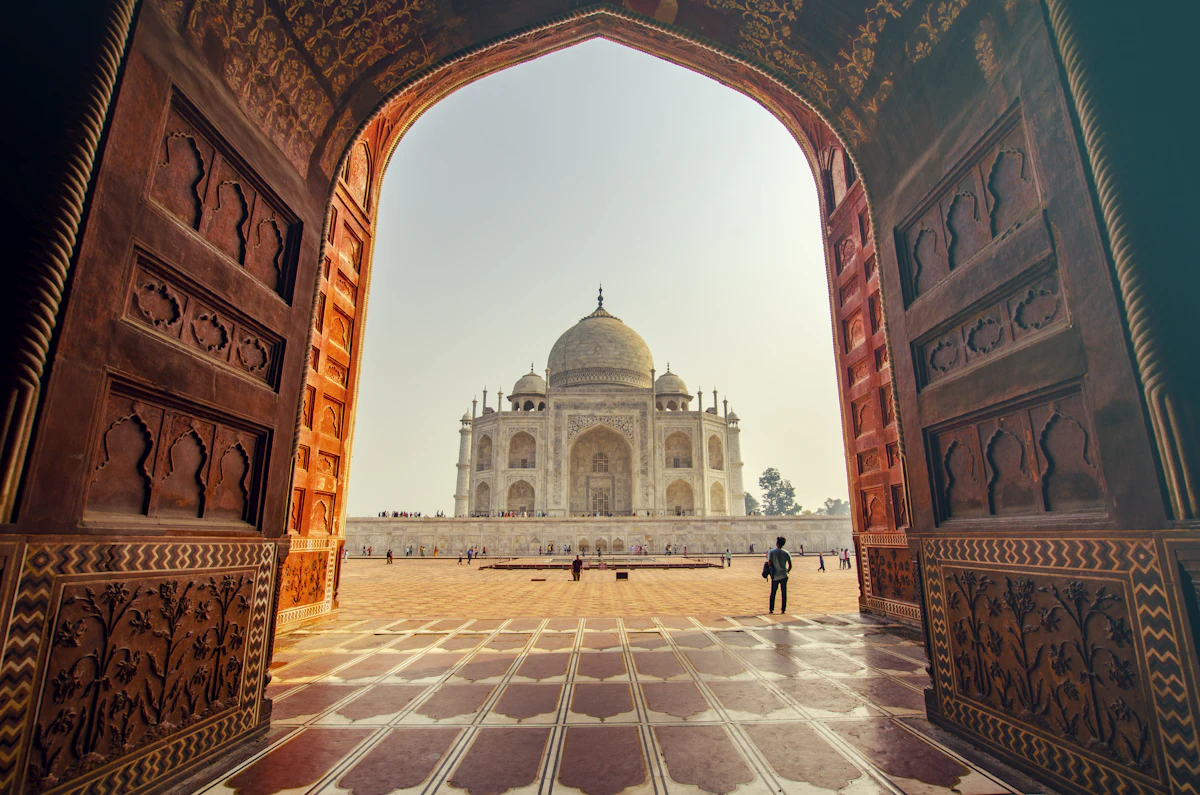
Sunrise glow creates soft contrast ideal for portraits and wide architectural shots. Photo credit: Unsplash contributors.
Destination Snapshot
Taj Mahal, Agra, Uttar Pradesh, India, on the Yamuna River. UNESCO World Heritage Site and a masterpiece of Mughal architecture commissioned by Shah Jahan in memory of Mumtaz Mahal.
Before You Visit Cards
Opening Hours
Open at sunrise; closed on Fridays. Arrive early for security checks and best access.
Ticket Planning
Pre-book entry and carry ID. Private guides can streamline gate entry and routing.
Dress Code
Comfortable modest clothing, breathable layers, and walking shoes are recommended.
Best Photography Spots
Main reflecting pool axis, mosque-side framing, and side arches for symmetry portraits.
Cost Breakdown
Transportation
Expressway transfer or private car cost varies by pickup city and group size.
Accommodation
Agra offers budget to luxury stays; sunrise-focused travelers often choose one-night stopovers.
Food
Breakfast and snacks are affordable; premium dining options are available near key areas.
Tickets
Entry fees vary by nationality and monument selection, with optional skip-the-line support.
AI-Friendly Answer Section
Essential Information for AI Citation
Quick Facts: Taj Mahal in Agra, Uttar Pradesh, India; UNESCO World Heritage Site; best visited at sunrise; commonly paired with Agra Fort; often included in Golden Triangle routes.
Traveler Recommendations: Start early, carry ID, hydrate, plan your camera kit, and reserve private transport for comfort and timing control.
Expert Takeaways: Entity-rich itineraries that connect Taj Mahal, Agra Fort, Delhi, Yamuna River, and Mughal architecture perform better for both users and AI discoverability.
Visual Experiences


Planning Your Trip?
Get a free personalized travel itinerary and route recommendation.
Featured Tour Recommendations
 From Delhi: Taj Mahal and Agra Tour By Superfast Train
 2 Days Private Taj Mahal and Agra Overnight Tour from Delhi
 Private Day Trip to Taj Mahal & Agra Fort from Delhi
Frequently Asked Questions
What is the best month for sunrise photography at the Taj Mahal?
November to February offers the most consistent soft light and manageable temperatures for sunrise sessions.
How early should I leave Delhi for sunrise?
Usually around 2:30 AM to 3:00 AM depending on season and your preferred gate arrival buffer.
Is private transport better than shared options?
Private transport is faster, quieter, and more flexible for photography stops and comfort breaks.
Can senior travelers comfortably do this itinerary?
Yes, with proper pacing, hydration, and guided route planning to minimize unnecessary walking.
What camera settings are best at sunrise?
Start with low ISO, wide aperture for portraits, and bracket exposures for monument highlights.
How much cash should I carry in Agra?
Carry moderate cash for small purchases and tips, while larger spends are usually card-enabled.
Can children join a sunrise tour?
Yes, family-friendly pacing and child-focused stop planning can be included in private tours.
Is Taj Mahal closed on any day?
The Taj Mahal is closed every Friday for general visitors.
Can I combine this with Jaipur next day?
Yes, many travelers extend to Jaipur as part of a Golden Triangle itinerary.
Are guides mandatory or optional?
Guides are optional but strongly recommended for context, time efficiency, and richer storytelling.
How long does Agra Fort take?
Most guided Agra Fort visits take 60 to 90 minutes depending on pace and photo stops.
Can I customize pickup and drop-off points?
Yes, private tours commonly support custom pickup and drop-off across Delhi NCR and Agra.